
Student Name
Capella University
MBA-FPX5002 MBA Leadership
Professor Name
Submission Date
[blur_section id=”postinstructions” button=”Free Download” form_id=”fdfac57″]
Defining Yourself as a Leader
Leadership in organizations is not solely about positional authority anymore and it means knowing yourself, being flexible, having integrity, and a constant drive for improvement. This business report is the self-analysis of my leadership identity, which has been formed through the results of my leadership self-assessment, feedback from reflective practice, and academic research. This report is designed to clarify my strengths, identify areas for growth, and develop a clear path for my leadership by creating a personal SWOT analysis and SMART growth goals. Through the process, I will be able to equate personal values and expectations of professional leadership in dynamic learning contexts.
My Strengths
1. Communication and Interpersonal Effectiveness
Leadership communication brings about trust, clarity, and engagement in teams. My Communication Style Self-Assessment (Table 1) shows that my main tendencies relate to the Analytical and Amiable communication styles. Such a combination is an expression of a leader who believes in precision, organization, and consideration when making decisions and who is still sensitive to relationships and teamwork. I tend to express myself clearly, back up my statements with supporting evidence, and encourage discussion and problem solving, particularly in groups.
Analytical | 45% |
Amiable | 30% |
Driver | 13% |
Expressive | 12% |
(Table.1)
These results were confirmed by peer and colleague feedback, which stated that my communication style is thoughtful, clear, and structured but not strict. Research findings show that good communication skills and empathy are essential to a leader to foster a trustful ad engaging environment (Marbun et al., 2023). This balance helps me to convert intricate information into practical insights and also be psychologically safe in teams.
2. Adaptive and Ethical Leadership
The Agile Leadership Self-Assessment shows that I have a high ability in agility of learning (35 out of 40), agility of interpersonal performance (30 out of 40), and agility of execution (33 out of 40), specifically in the fields of being curious, open to feedback, and decision-making in teams. These attributes are helping me to respond positively to uncertainty and organizational requirements.
Learning Agility | 35 out of 40 |
Interpersonal Agility | 30 out of 40 |
Execution Agility | 33 out of 40 |
(Table. 2)
Ethical leadership was a positive attribute. I always base my decision-making processes on fairness, transparency, and accountability. It is also vital to have ethical leadership to ensure trust within the organization and long-term performance (Zhu et al., 2025). Workers observed that I am responsible and principled, particularly in balancing conflicting priorities.
3. Total Leadership Skill Score
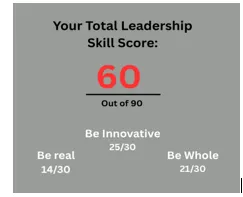
As per my total leadership skills assessment score (See Figure 1), I am slightly below the global average of 60 out of 90. Strengths were also explained in the areas of Be Innovative (25/30) and Be Whole (21/30) that dealt with creativity and personal integration. Despite this, the lowest score was achieved by Nonetheless Be Real, suggesting that increasing genuineness is a must, particularly for having challenging conversations and setting boundaries. This is in line with peer feedback that considered me to be too accommodating and my personal habit of not wanting to conflict. Through the evaluation, I know that I will build bold communication as one of the leadership priorities.
Figure 01
Total Leadership Skills Assessment Score
Personal SWOT Leadership Statement
My mission as a nurse leader will be to fail to accept any environment where care is not provided with ethical, interdisciplinary, and inclusive principles by empowering the teams, holding them accountable to each other, and inspiring them to learn throughout their careers. My leadership philosophy is based on the principle of integrity, equity, professionalism, collaboration, and respect. These principles will be used to support informed decision-making, communication, and application of quality and safety in healthcare settings, particularly in complex and challenging clinical environments.
Table 01
SWOT Analysis
Strengths · Good analytical and problem-solving skills based on my academic and clinical self-assessment, to enable evidence-based decisions. · • Excellent receptivity to feedback; significant degree of personal interest in self-development which supports professional development and flexibility. · • Integrity and judgment: ethical issues are consistent with the nursing professional standards and patient advocacy. · It possesses a communication style that is clear and supportive, and promotes a sense of trust, collaboration and psychological safety within interprofessional teams. | Weaknesses · An over-analytical way of thinking about decision-making could result in a delay in a time-sensitive clinical or leadership situation. · The reluctance to take on complex assignments because of the amount of responsibility and accountability that is reflected in self-reflections. · Avoids confrontational conflict when stressed; can limit assertiveness in challenging leadership situations. |
Opportunities · Further advance to strategic and transformational leadership positions via formal education and mentoring. · • Develop power in inter-disciplinary and inter-departmental work for improved patient outcomes and organizational results. · Implementing health care technology and data-driven tools to enhance the effectiveness of quality improvement, efficiency and staff engagement. Threats Risk of not reacting in time and with corrective actions in a hectic healthcare environment without improving decision-making. | Threats · Further advance to strategic and transformational leadership positions via formal education and mentoring. · • Develop power in inter-disciplinary and inter-departmental work for improved patient outcomes and organizational results. · Implementing health care technology and data-driven tools to enhance the effectiveness of quality improvement, efficiency and staff engagement. Threats · Risk of not reacting in time and with corrective actions in a hectic healthcare environment without improving decision-making. |
This SWOT analysis is a personal reflection of who I believe I will be as a nurse leader as a thoughtful person who has values and is an ethical person. I believe that my strengths are collaborative leadership and a patient approach, while my reflections suggest that I need to develop my skills and abilities in designing decisions, delegating tasks, and managing conflicts. Research suggests that effective leaders should not be overly moralistic and should make sound decisions quickly to be effective in fast-paced health care settings (Engin & Kasap, 2025). Through intentional development of these skills, I will be able to integrate my leadership practice with my purpose and values, and deliver outcomes and high-quality care that is sustainable in interprofessional health care environments.
Growth Opportunities
The leadership development process is ongoing and should be purposeful to set goals (Bahrami et al., 2022). As a result of the self-assessment, there were two priorities identified for growth: the ability to make decisions under pressure and to effectively delegate.
SMART Goal 1: Enhance Leadership with Power.
Specific: Improve the speed of decisions in operation, incorporating systematic decision-making structures.
Measurable: Decision turnaround time to be reduced by 25 percent within six months, which is measured in the project timelines.
Achievable: Use decision-matrix tools and include weekly reflection reviews.
Relevant: On-time decisions are more responsive and credible to the organization.
Time-Bound: Achieve improvements in targets within 6 months.
SMART Goal 2: Improve Team Empowerment and Delegation.
Enhance Team Empowerment & Delegation.
Specific: Assign at least one significant element of a project to members of a team per month.
Measurable: Record task ownership/achievement outcomes.
Achievable: Ensure clear expectations and further checks for follow-up.
Relevant: Delegation enhances team competence and eliminates burnout in leaders.
Time-Bound: To be followed regularly in the next two academic terms.
Personal Leadership Statement
I am a creative, critical, and dynamic leader who values ethical decision-making, working cooperatively, and continuous learning. I aim to build a space where people are looked up to, educated, and given the power to make significant contributions. Cooperative leadership strategies have been shown to achieve continuous results clearly and with quality management (Laureani et al., 2024). My purpose as a leader is to lead in the face of complexity in an unambiguous, honest, and thoughtful way and to be ready and willing to grow and self-reflect.
Conclusion
This report has confirmed my leadership identity through systematic self-evaluation, introspection, and academic bases. The findings show a leadership style that is ethical, flexible, and analytical, and that is clearly shown.
the areas that need improvement. By keeping certain SMART objectives in mind and following my own rational approach to leadership, I can be more decisive, empowering, and resilient to tackle the challenges of the contemporary organizational context.
[/blur_section]