

Adaptation and Succession
Breeders and farmers know that the traits of individuals within a species vary. For example, some plants may produce larger fruit than average for the species and some cows may produce more milk than average. The breeders are able to modify species over many generations by selecting individuals with the desired traits and intentionally mating those individuals together. This process is called artificial selection. If such changes can occur over several generations by intentional artificial selection, then a similar natural selection of beneficial traits should be capable of modifying a species over hundreds or thousands of generations.
Lesson Focus
Adaptation and natural selection often get confused with each other. Use these questions to think about what you may already know about this lesson focus:
- Imagine you lived in an area near the equator all your life and your cousins invited you to spend a year with them in Alaska. What choices would you make to adapt to the change in climate? How have the populations in Alaska naturally adapted in that environment?
- Scientists believe that today’s varieties of dog breeds were all independently domesticated from wild dogs. What other benefits can artificial selection provide humans?
Though farmers use artificial selection when they choose individual plants or animals with the traits that they prefer to pass on to the next generation, nature has its own way of causing ecosystems to change over time
Enduring Understanding
Ecosystems have structure and diversity that change over time.
Learning Objectives
- Describe how organisms adapt to their environment.
- Describe ecological succession.
- Describe the effect of ecological succession on ecosystems
Essential Knowledge
- Organisms adapt to their environment over time, both in short- and long-term scales, via incremental changes at the genetic level.
- Environmental changes, either sudden or gradual, may threaten a species’ survival, requiring individuals to alter behaviors, move, or perish.
- There are two main types of ecological succession: primary and secondary succession.
- A keystone species in an ecosystem is a species whose activities have a particularly significant role in determining community structure.
- An indicator species is a plant or animal that, by its presence, abundance, scarcity, or chemical composition, demonstrates that some distinctive aspect of the character or quality of an ecosystem is present.
- Pioneer members of an early successional species commonly move into unoccupied habitat and over time adapt to its particular conditions, which may result in the origin of new species.
- Succession in a disturbed ecosystem will affect the total biomass, species richness, and net productivity over time.
Evolution
Public Domain
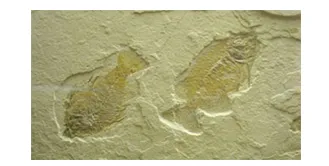
If a crime has been committed without any eyewitnesses, detectives look for a range of different types of evidence to help them solve the puzzle and determine what happened. In a similar way, scientists use fossils, DNA sequences, structural similarities, and other types of evidence to determine what happened in the past, how the organisms on Earth are related, and how there came to be such a variety of life on the planet today.
This is how scientists develop and support the theory of how life evolved on Earth. The current scientific views about evolution did not develop overnight. Like many other scientific theories, the theory of evolution is built on observations, scientific analysis, and evidence discovered by many different scientists working in several different fields.
In science, the term evolution refers to a change in allele frequencies (genetic material) in a population over time. This change in a population demonstrates how life on Earth transformed from its earliest forms to the vast diversity on Earth today. These changes are based primarily on the interactions of organism populations and their environments.
Charles Darwin made important contributions to that theory with his own interpretations of the evidence. As he explored a range of habitats on the continents of South America, Australia, and Africa, Darwin carefully recorded his observations of various organisms. Darwin noticed three patterns of biological diversity during his travels: species vary globally, locally, and over time.
Species vary globally
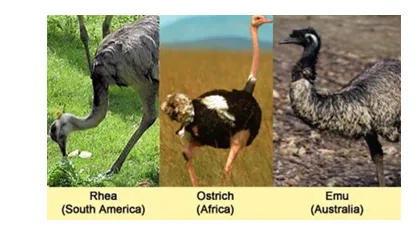
Darwin noticed that comparable ecosystems in different parts of the world have some similar, but unique organisms. For example, he found large flightless birds in the grasslands of Australia, Africa, and South America.
2011 Public Domain/John Foxx/Tom Brakefield/Thinkstock
These birds are all similar in that they are large and flightless, but they are unique in other aspects and do not appear to share a close common ancestor.
Comparable ecosystems around the world do not always support the same species. Rabbits thrive in the grasslands of Europe, but are not native to the grasslands of Australia or Africa. Kangaroos are unique to the grasslands of Australia and are not found on other continents. What caused the differences in species between continents?
Species vary locally
Public Domain
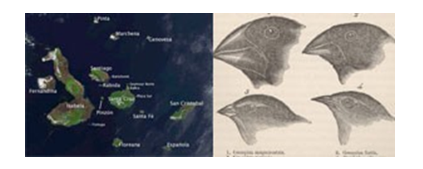
The most obvious difference between the 13 finch species on the Galapagos Islands is their beaks, which have different shapes depending on the species’ diet.
Darwin also observed unique, but closely related, species in different regions of the same area or continent. For example, the Galapagos Islands are a group of islands off the Pacific coast of South America. These islands are close together, but each has its own unique ecosystem. It appeared as if plants and animals from the South American mainland inhabited these islands, but those species had diversified to become unique species on each island. Darwin collected 13 types of finches from the Galapagos Islands. These finches were similar in many ways, but each came from a population with enough unique features to be considered its own species. Some types of finches were only found on one island, while others could be found on two or three islands that were close together. Several of the islands also had large tortoises that seemed similar at first, but each island’s tortoise population has its own unique shell shape.
Species vary over time
Darwin also collected fossils of extinct species on his voyage. Some of these fossils resembled living organisms, while others did not. For example, Darwin unearthed a fossil of the extinct armored animal called the glyptodont. The smaller armadillo lived in the same region and resembled this ancient animal. Darwin was certain that the glyptodont would prove to be an ancestor of the modern-day armadillo.
Natural Selection
Changes over time in populations, and consequently communities, are also the result of evolution. Evolution has two primary results:
- new species develop over time
- existing species become modified to survive in a changing environment
Charles Darwin was not the first person to suggest that evolution was responsible for the diversity of life on Earth. But he did suggest a way in which evolution worked: through natural selection. Organisms with the best adaptations are more likely to survive, and organisms with maladaptive traits are less likely to survive. Natural selection occurs in response to both biotic and abiotic components of an ecosystem. Because of these complex influences, evolution plays a significant role in producing niches for organisms.
Many species show evidence of coevolution. For example, suppose a particular population of beetles parasitizes a population of maple trees. Some of the maple trees may develop the ability to produce a natural insecticide, which kills the beetles. Beetles that are more resistant to the insecticide are more likely to survive. Over time, most of the beetle population will be resistant to the pesticide. As the pesticide resistance in the beetles increases, trees that produce larger quantities of the insecticide will be better able to survive. In this way, the traits of the beetle population affect the traits of the maple tree population, and vice versa.
Community Ecology Text Version
Zion National Park
Zion National Park is the result of downcutting—the process of a river wearing down rock in a vertical fashion. The downcutting at Zion was caused by the Virgin River, which has produced steep walls that surround the canyon. The steep walls and the river form geographical boundaries for many species, allowing them to become isolated. Organisms that live in the desert swamp, such as the leopard frog and tree frog, are adapted for lives in and near the water.
Crystal Springs Preserve
Crystal Springs Preserve contains a large spring where groundwater rises to the surface through cracks in the limestone. In this area, only species that can live in wet conditions on the ground, such as frogs, or drier conditions in the trees can survive.
Yellowstone
Yellowstone is on a high plateau at 8,000 feet, surrounded by the Rocky Mountains. Much of the high plateau is a caldera—a basin-like depression that forms when the magma chamber beneath a volcano collapses, causing the rock above it to sink. The hot rock and magma that still exist below the caldera produce the mud pots and geysers for which Yellowstone is famous. However, Yellowstone also contains high alpine meadows without any geothermal elements. Organisms dwelling near the geothermal areas need to be able to survive high temperatures, and organisms that live in the high alpine meadows need to be able to survive the harsh winter snows: bears hibernate, white pelicans migrate south, and elk and bison develop thick coats and migrate to lower elevations.
So why are there similar organisms living in the desert swamp at Zion National Park and at the spring at the Crystal Springs Preserve? These organisms are filling similar niches in similar environments. And why are the organisms at Zion National Park and Yellowstone National Park so different? They are filling completely different niches in environments influenced by different abiotic factors.
Natural selection is a mechanism for the evolution of a population to become better adapted to its local environment over many generations. Let’s take a look at some of the main principles of natural selection: variation, overpopulation, adaptation, and descent, with modifications.
Changing Environments
Populations change from generation to generation, as they become better adapted to the environment. Natural selection does not move in a fixed direction. If the conditions of the environment change, some traits that were once beneficial adaptations may no longer be useful. Such environmental changes may include a climate change, introduction of new species of plants or animals, or pollutants and other human influences. When such changes occur, new traits may become the adaptations that allow for survival in the new environmental conditions. If environmental changes occur faster than a species can adapt to those changes, the species may become extinct.
Examples
Let’s examine some examples of natural selection. For each example, notice how natural selection influences the population by allowing the individuals with the favorable adaptations to survive and reproduce more often than others. Also note how changes in the environmental conditions can change the traits that are beneficial to the organisms.
Rat Snakes
There are many populations of rat snakes found throughout North America. All rat snakes have similar diets, are excellent climbers, and kill their prey by constriction. However, rat snakes come in a wide variety of colors, from black to yellow-striped to orange or green. Varieties of colorations are dominant in different populations, depending on the region where they are found. This is because each population has evolved over time through natural selection, with the coloration that proves most beneficial for camouflage in that environment becoming dominant. The individuals that are best able to blend into their environment are better able to hide from potential predators and prey, allowing them to survive and reproduce to pass on the genes for that beneficial coloration.
Antibiotic-resistant Bacteria
Antibiotics are used to fight bacterial infections. A large population of bacteria will include individuals that vary in their genetic makeup due to mutations that occurred during DNA replication. When exposed to antibiotics, most bacteria in a population die quickly. However, some of the individuals in this large population of single-celled bacteria may have mutations that help them survive the exposure to the medication.
The surviving bacteria divide rapidly, producing the next generation of cells in a short timeframe. The majority of the individuals in this new population will inherit that trait that allowed the “parent cells” to survive the antibiotic exposure. Given enough time and multiple exposures to one type of antibiotic, a population of bacteria can develop an antibiotic resistance. The bacteria known as MRSA (methicillin-resistant Staphylococcus aureus) is sometimes called a “superbug” because it is now resistant to many types of antibiotics. As bacteria populations continue to develop resistances to antibiotics, we struggle to find ways to fight the diseases that they cause.
Peppered Moths
A commonly cited example of natural selection involves the peppered moth of Great Britain and Ireland (Biston betularia). Two main varieties, differing in their coloration, are found throughout the English Midlands. One variety is light colored with dark spots, and the other is uniformly dark. Both types of moths feed at night and rest during the daytime on trees or rocks covered with light-colored lichens. The light-colored moths are more camouflaged against this background, while the dark moths were easily spotted and eaten by birds. Before the Industrial Revolution, the dark moths were very rare because most did not survive long enough to reproduce and pass on the genes for dark coloration.
When industrial pollution darkened the countrysides landscape in the late 1800s, the light moths became easier to see against the now dark backgrounds. The number of dark moths within the population started to increase while light moths decreased, because now the dark coloration was a beneficial adaptation in this new environment. By the turn of the century, the population of peppered moths in the Manchester region was almost entirely dark in color. Once the peak of the Industrial Revolution passed, lighter moths started to make a comeback as the countryside became less polluted.
Galapagos Finches
An image of a graph that displays the patterns of natural selection in Galapagos finches. The x axis displays the years, and the y axis displays the beak size. 1978 was a dry year, and the beak size measures 9.9 millimeters. 1980 was a dry year, and the beak size measured about 9.7 millimeters. 1982 was a dry year, and the beak size measures 9.8 millimeters.
The 13 types of finches found in the Galapagos Islands share some similarities, but each population has its own unique traits, as well. The most prominent differences between the populations are the shapes of their beaks, which are adapted for specific diets. Some beaks are used to eat seeds or berries, others hold sticks to probe for food, while others hunt for insects or grubs.
One type of finch, called the medium ground finch (Geospiza fortis), uses its strong beak to crush seeds. They primarily feed on small seeds that are produced in abundance during years with large amounts of rain. Scientists have observed that in dry years when those seeds are in short supply, these finches resort to eating larger seeds that are harder to crush. Variation of beak shape and size occurs even within a single population. During long droughts, the medium ground finches with larger beaks are able to crush those large seeds better than those with smaller beaks. This means that the finches with larger beaks are more “fit” for the dry conditions, so they survive and reproduce more often than those with small beaks during a drought. In years with very high amounts of rain, more birds with the smaller beaks survive to produce offspring.
Let’s look at another example. When you think about penguins, what kind of habitat do you picture them in?
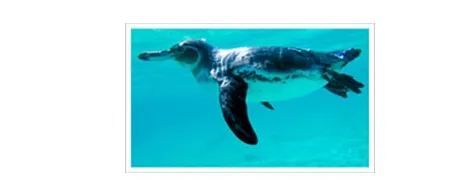
Would you be surprised to learn that penguin habitats range all over the Southern Hemisphere, and the Galapagos penguin lives on the equatorial Galapagos Islands, in an average temperature of 73°F? It’s true! There are many different penguin species, illustrating one example of the diversity of life. Penguins are already pretty unusual birds, using their wings to fly through the water instead of the air, and the Galapagos penguin is even more unusual than most.
To cope with the sun, heat, and variable food supply, the Galapagos penguin (Spheniscus mendiculus) has some interesting physical adaptations. Cool waters from the Humboldt and Cromwell currents provide a nice place to swim during the day, but Galapagos penguins still often need a way to cool off from the fierce equatorial sun. They cannot sweat, but they can pant like dogs. These penguins also have less body fat and fewer feathers than cold-water species. Galapagos penguins are one of the smallest penguin species, which means they can exist on fewer calories during periods when food is scarce.
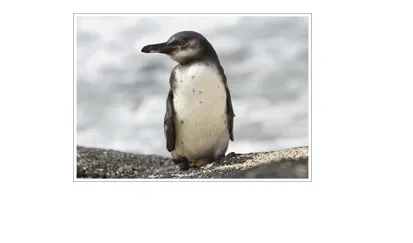
It sure can be a struggle to survive out in the ocean, especially if you’re not one of the top predators. How do adaptations help an organism survive? Let’s look at some of the unique adaptations in marine life:
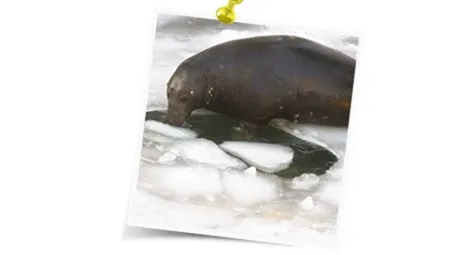
How do marine mammals keep from freezing to death in Arctic waters?
Fur or blubber! Dense hair traps a layer of air just above the skin for insulation. Animals that spend most of their time in water rely on blubber, which is a layer of tissue containing fat, collagen, and elastin. Blubber provides insulation and energy storage for marine mammals, the same as fat does for humans.
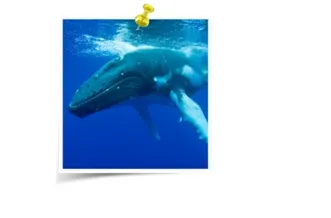
Is it true that whales can hold their breath for more than 90 minutes?
Yes! Whales are air-breathing mammals. Like other diving mammals, whales have oxygen- binding proteins called myoglobin in their muscles, and they can store extra oxygen to use while underwater.
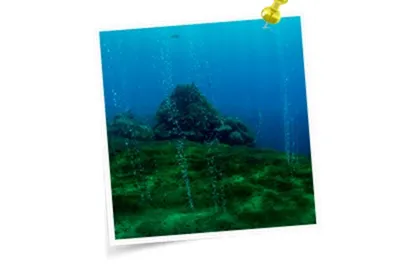
How is energy produced at the bottom of the ocean, where there is no sunlight?
Most forms of producers such as plants and algae use the sun as an energy source. However, in the deep ocean, beyond the reach of the sun, hydrothermal vents pump superheated water thick with chemicals from the seafloor. Hyperthermophiles, which are microorganisms that can reproduce and grow at temperatures 90°C and above, have adapted to these extreme conditions.
Ecological Succession
Large scale ecological events, called successions, can change the composition and development of entire ecosystems in drastic ways. As you’ve seen, communities do not remain the same over time. To make the best use of the available resources, including sun, water, and nutrients, they change through succession from pioneer communities to climax communities when they reach their carrying capacity, which can be calculated by averaging the high and low of the population.
You can compare pioneer communities to climax communities in the table below:
Succession is divided into relatively rare primary succession after events such as a volcanic eruption or the retreat of a glacier, and more prevalent secondary succession after an event such as the development of a vacant lot, the clear-cutting of a forest, or a forest fire. Let’s look at each of these successions below:
Secondary Succession Effect on Ecosystems
The first of these, primary succession, is the progression of growth that develops on newly- formed land or surfaces. Primary succession must begin with bare rock. For instance, on the island of Hawaii, active volcanoes are part the island ecosystem. The youngest of the volcanoes, Kilauea, produces 250,000–650,000 cubic yards (200,000–500,000 cubic meters) of lava per day. This lava becomes new rock and then new land as soil builds upon it. In the pioneer community, lichens attach themselves to the rock. As the lichens grow, they break apart the rock (physical weathering). In addition, their cells secrete acids that dissolve some of the minerals in the rock (chemical weathering). Lichens are made up of fungi that live with photosynthetic algae; the fungi provide protection and nutrients for the algae, and the algae supply the fungi with food.
This mutualistic relationship allows the lichens to survive in even the most barren environments. As the lichens break down the rock, they produce thin soil. Over time, mosses can begin to grow in the soil; the mosses may eventually displace the lichens. Seeds are blown by wind or dropped by birds into the new soil and begin to grow. Grasses and eventually shrubs can enter the community as the soil deepens, followed by small and, finally, large trees in a forest. These plants foster more vegetation, which attracts herbivores and omnivores. The new land becomes new habitat that supports the ecosystem and fosters population growth.
Primary Succession Text Version
Animation showing the progression in primary succession from rocks to lichens and mosses to grasses to shrubs to small trees to large trees.
Use the interactive below to check your understanding on adaption
The answer is: artificial selection
The answer is: fitness
The answer is: Adaptation
The answer is: variation, overpopulation, and inheritance
The answer is: Adaptations are specific to the current environment, and may no longer be beneficial if the environment changes
Assessment
In this lesson, you studied how ecosystems change over time through adaptation and the process of succession. Natural selection is a mechanism of evolution. A population of organisms already has variations in its traits, and some of those variations are more beneficial in a given environment than others. You reviewed primary and secondary succession, pioneer communities, and climax communities. You also looked at the important role keystone species and indicator species have in a community. Lastly, you examined the effect succession has over time on biomass, species richness, and net productivity in a disturbed ecosystem.
Natural Selection Activity
Predation is a major driver of evolution. Prey with beneficial adaptations that allows them to live longer or successfully evade a predator will survive and pass on those adaptations to many or all their offspring. As time goes on, this natural selection can cause traits to become more or less common within a population. But how do those traits impact the population’s survival due to other events?
For this activity, download and complete the Natural Selection Worksheet as you work through the simulations. Consider reviewing the Graphing Tutorial in the Toolkit for the data analysis section of the lab report. Be sure to review the grading rubric before submitting for grading.
Natural Selection
Introduction:
In this activity, we will explore the scientific theory of evolution by analyzing survival rates of a species due to changing environments.
Natural Selection Activity Rubric
02.04 Adaptation and Succession Assessment
- Check your understanding of important concepts.
- Complete the Natural Selection Worksheet.
- Submit the 02.04 Adaptation and Succession activity.