

Student name
Capella University
MHA-FPX5017 Data Analysis for Healthcare Decisions
Professor name
Submission date
Slide 1
Presenting Statistical Results for Decision Making
Hi everyone. My name is ______ and today I’ll be discussing the statistical results as well as with a recommendation and plan of action for health system leadership.
Slide 2
Data Collection, Measurement, and Analysis Tools and Techniques
Data analysis was conducted using sound quantitative techniques such as descriptive statistics (n=95), correlation, and multiple linear regression modeling to explore the relationships of nursing staffing variables with the rates of HAcs. In strengths, this study utilized appropriate statistical tests and obtained significant results (R²=0.644, p<0.05), as well as comprehensive and detailed measurements of the variables, such as nursing hours per patient day, the skill mix, and average length of stay. In healthcare, good data visualization techniques can help to interpret the results and make informed decisions based on the data (Abudiyab & Alanazi, 2022). The study’s limitations are that the study is cross-sectional, and it has been noted that there may be some variables other than simply staffing that could influence the rates of HACs.
Slide 3
Interpretation of the Statistical Results
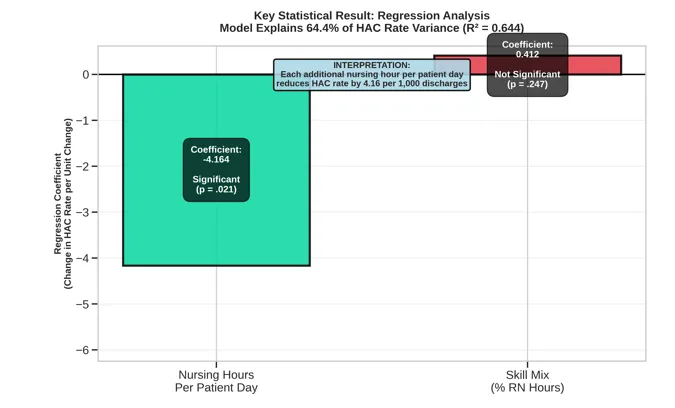
Results of the regression analysis result in a strong negative correlation (r=-0.799) between nursing HPPD and HAC rates, whereby each additional HPPD is associated with a decrease in HAC rates by about 4.16 per 1,000 discharges (p=0.021). The model accounts for 64.4% of the variation in HAC rate, suggesting that it has good predictive power. In the context of healthcare, statistical significance is crucial for interpreting the results and ensuring they are applied correctly in hospital administration. Healthcare administration relies on the correct interpretation of statistical significance in tandem with clinical significance to ensure accurate application of statistical analysis in healthcare (AbdulRaheem, 2024). On the other hand, skill mix had no significant correlation with HAC rates (p=0.247), and average length of stay had a moderate positive correlation (r=0.417) with HAC incidence, which implies that the longer it was spent in hospital, the higher the risk of an infection was.
Slide 4
Key Statistical Results to Support a Recommendation and Plan of Action
There are three important statistical findings that suggest that more nursing HPPD at St. Anthony Medical Center is recommended. The strong negative correlation (r=-0.799, p=0.021) also provides some methodology for managers to quantify the impact of staffing changes on a HAC rate and to present a “nurse of the dollar” argument to the board for staffing increases. Second, managers can be 64% confident in the regression model’s prediction when they are proposing staffing interventions, as the R²=0.644 means 64% of the variance is accounted for by the model. Staffing models that are based on evidence have a measurable impact on patient safety measures (Udina et al., 2025). Third, the skill mix is statistically insignificant (p=0.247), and managers can make cost-saving decisions on investing in the total nursing hours with the $72,000/nurse budget, rather than in costly changes in the RN-to-LPN ratio, which would increase total HPPD strategically.
Slide 5
Recommendation and Plan of Action
The results of statistical analysis strongly indicate that there is a need to increase the number of nurses in St. Anthony Medical Center. A strong negative correlation (r = -.799, p = .021) is shown between the number of nursing hours per patient day and the rate of hospital-acquired conditions in Figure 1. This relationship has been quantified in Figure 2 using regression analysis, and results show that with each additional nursing hour, there is a decrease of 4.16 HAC per 1,000 discharges with a model R-squared of 64.4%. No significant association was found with skill mix (p = .247), meaning that it is the nursing hours that are affecting HAC prevention. Given these strong results, an increase in staffing (from 3.94 to 6.0 HPPD) through the addition of 47 new nurses would be helpful.
Figure 1
Correlation Between Nursing Hours Per Patient Day and Hospital-Acquired Condition Rates (r = -.799, p < .05)
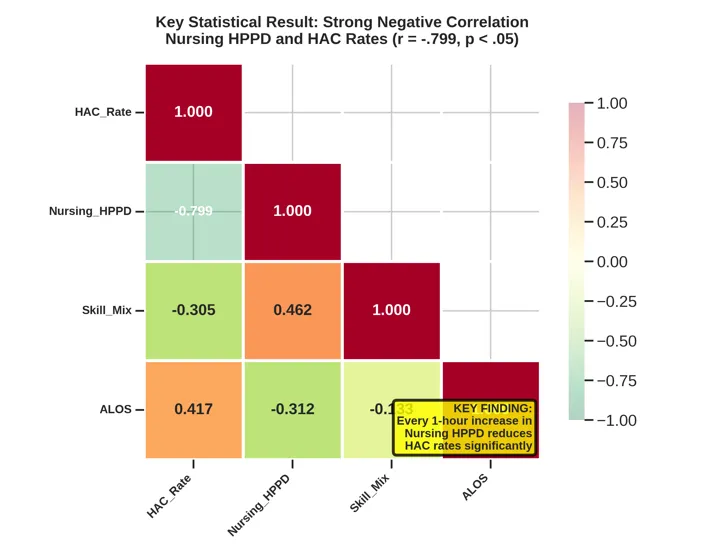
Figure 2
Multiple Regression Coefficients Showing Impact of Nursing HPPD and Skill Mix on HAC Rates (R² = .644)
Slide 6
Cost-Benefit Analysis and Implementation Plan
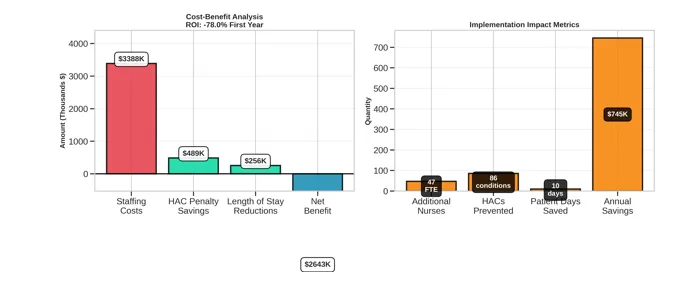
Part of our staffing investment of $3.39 million annually results in avoiding HAC penalties of $489,000 annually and reducing length of stay by preventing 86 HACs (Figure 3). There is strong evidence that appropriate staffing with nurses based on the outcomes of measurements enhances patient safety and the outcomes of the organization (Dall’Ora et al., 2022). In addition to monetary benefits, this suggestion improves the quality score, meets the regulations, and will improve the hospital’s reputation. The 12-month implementation plan is broken down into three phases: Recruitment and hiring (months 1-3); Training and orientation (months 4-5); and Full deployment with continued monitoring (months 6-12) to maximize the value of the statistical prediction in tangible patient safety benefits.
Figure 3
Cost-Benefit Analysis of Proposed Nursing Staffing Enhancement Initiative
Slide 7
Conclusion
There is statistical data that strongly supports a larger number of HPPD (doubling to 6.0 HPPD) at St. Anthony Medical Center. There is a strong correlation (r=-.799), and regression analysis shows that this investment will avoid 86 additional hospital-acquired conditions per year, and will positively impact patient safety and quality. Despite the high upfront cost of $3.39 million, which still needs the approval of the board, the evidence shows the tangible benefits in reduction of the HAC, regulatory compliance, and reputation of the hospital, which are experienced by the staff and are measurable, making this an evidence-based decision for the staff. Implementation starts at go-live and will be completed within 12 months to reach the desired patient safety targets.
References
AbdulRaheem, Y. (2024). Statistical significance versus clinical relevance: Key considerations in interpretation medical research data. Indian Journal of Community Medicine, 49(6), 791–795. https://doi.org/10.4103/ijcm.ijcm_601_23
Abudiyab, N. A., & Alanazi, A. T. (2022). Visualization techniques in healthcare applications: A narrative review. Cureus, 14(11), e31355. https://doi.org/10.7759/cureus.31355
Dall’Ora, C., Saville, C., Rubbo, B., Turner, L., Jones, J., & Griffiths, P. (2022). Nurse staffing levels and patient outcomes: A systematic review of longitudinal studies. International Journal of Nursing Studies, 134, e104311. https://doi.org/10.1016/j.ijnurstu.2022.104311
Udina, M.-E. J., Adamuz, J., Samartino, M. G., Pérez, M. T., Martínez, E. J., Morello, C. B., Merchanskaya, O. P., Zabalegui, A., & Jiménez, M.-M. L. (2025). Association between nurse staffing coverage and patient outcomes in a context of prepandemic structural understaffing: A patient‐unit‐level analysis. Journal of Nursing Management, 2025(1), e8003569. https://doi.org/10.1155/jonm/8003569