

Student Name
Capella University
PM-FPX5332 Project Management Planning, Execution, and Control
Professor Name
Submission Date
[blur_section id=”postinstructions” button=”Free Download” form_id=”fdfac57″]
Project Scope Statement
Note: Any work not explicitly included in the Project Scope Statement is implicitly excluded from the project.
Project Name | Implementation of Hospital Patient Scheduling System |
Prepared By | Name, Designation |
Date | _ |
Version History (insert rows as needed): | ||
Version | Date | Comments |
1.0 | —– | Initial Project Scope Statement created |
1. Executive Summary |
Provide below a brief overview of this project (for example, project purpose and justification). |
The project seeks to introduce a centralized digital hospital patient scheduling platform to enhance the experience of appointments, patient wait times, no-show rates, and provider utilization. The system that is in place in the present scheduling process is decentralized across the various departments and is partly manual, which has led to booking errors, untimely appointments, and poor utilization of resources. Internal audit approximates inefficiency of scheduling leads to a delay rate of about 20 -25 percent on appointments and a no-show rate of 15 percent. The solution that is proposed is a secure and integrated scheduling platform enabling real-time booking of appointments, automated reminders, visibility of providers’ calendars, and dashboards. The estimated budget of the project would be $85,000, and the project will be done within a 180-day window. Studies have shown that the adoption of digital systems of schedule integration in hospital facilities can lead to a significant decrease in the duration of appointment delays and no-show rates and an increase in the utilization of providers, patient satisfaction, and overall efficiency of the organization (Betancor et al., 2025). Some of the major risks involved in the implementation of the system are resistance to user adoption, integration problems with the system, and a lack of training. This scope statement can be used as the official definition of what is included in the work and deliverables. |
Note: In any instance where there is a discrepancy between the Project Charter and the Project Scope Statement, the latter is considered authoritative. |
2. Business Objectives | |
2.1 Product Description (Solution) | Such a system would be a hospital-wide digital patient scheduling system that is integrated with the current patient records and departmental schedules so that centralized scheduling, automated notifications, reporting, and staff-only access can be achieved. |
2.2 Business Objectives | The following measurable business objectives will guide the implementation of the hospital patient scheduling system: · Reduce patient appointment waiting times by 30% within three months of system launch, compared with the current baseline delay rate of 20–25%. · Decrease patient no-show rates by 20% through the use of automated SMS and email appointment reminders. · Increase provider schedule utilization to at least 90% by improving visibility of available appointment slots and enabling centralized scheduling. · Implement the system within a fixed timeline of 180 days and within the approved project budget of $85,000. · Achieve at least 95% scheduling accuracy among staff during the training and onboarding phase, ensuring that appointment entries are correctly recorded in the system. · Reach at least 85% staff user adoption within the first 60 days after system deployment, ensuring effective integration of the new scheduling process into daily hospital operations. |
Research has demonstrated that patient wait times can be decreased by up to 30 percent, no-show rates can be reduced by 1520 percent, and the level of staff compliance with scheduling changes can be increased with the implementation of electronic scheduling systems, which have automated reminders, leading to increased system use and workflow efficiency (Carini et al., 2021). | |
3. Project Description | |
For each area below, provide sufficient detail to define this project adequately. | |
3.1 Project Scope | |
Includes (list deliverables): | Includes (Deliverables):· Requirements collection and workflow analysis. · Licensing and selection of software scheduling. · System configuration and setup. · Connection with the existing patient database (read-only access) · Role-based access setup · Automation (SMS/email) of appointment reminder. · Staff training sessions · Two department pilot testing. · Adjustments of the system with pilot comments. · Complete implementation at the hospital levels. · SOP documentation and user manuals. · Post-performance report implementation. |
Stakeholders involved in these activities include the Project Manager, Health IT Lead, Clinical Operations Lead, and departmental supervisors, who will ensure that the scheduling workflows align with clinical operations and patient care requirements. | |
Does not include: | Does Not Include:· New electronic health record (EHR) system replacement. · Bespoke software development other than configuration. · The replacement of the hardware of the computers in place · Implementation of the Telehealth platform · Billing system redesign · System maintenance contracts other than initial maintenance. |
3.2 Dependencies (External and Internal) | Dependencies (External and Internal)· The availability and maintenance of vendor software. · IT infrastructure preparedness. · Network sanity and security certification. · Co-ordination of departmental scheduling policy. · Adequacy of staff to train. · Data approval of the compliance office. |
The Health IT Lead will manage technical requirements, including integration of the system and infrastructure preparedness, whereas the Clinical Operations Lead will manage the involvement of the department and alignment of the workflow. | |
3.3 Assumptions | Assumptions· Pre-project budget approval is provided before the commencement of the project. · Vendor solution is in line with the needs of the hospital. · Integrations required are technically correct. · Training of workers will be held frequently. · Tracking the changes in workflow will be assisted by the leaders in the departments. · There is up-to-date patient information that can be utilized. |
3.4 Constraints | Constraints· Maximum budget: $85,000 · Fixed timeline: 180 days · Inadequate provision of IT staff. · None of any material time off. · Should be capable of abiding by the data privacy requirements on healthcare. · The training ought not to be in such a way that it disturbs the way patient care works. · These constraints have to be keenly handled by project stakeholders in order to be implemented. |
The Project Manager will schedule, allocate resources, and communicate with stakeholders to ensure that project goals are within reach with such constraints, with the Project Sponsor offering the strategic direction and oversight of resources. | |
4. Project Milestones | Target Date |
Milestone | Target Date |
Project Start | Day 1 |
Requirements & Workflow Analysis Complete | Day 30 |
Vendor Selection Complete | Day 50 |
System Configuration Complete | Day 95 |
Integration Setup Complete | Day 120 |
Pilot Testing Complete | Day 145 |
Staff Training Complete | Day 165 |
Full Deployment | Day 180 |
Project Complete | Day 180 |
5. Project Approach | |
In a few words, explain how each of the following will be addressed. Provide links to relevant documents as appropriate. | |
5.1 Change Management | Change Management The official change requests also shall be documented and assessed based on their impact (scope/time/cost) and approved by the Project Sponsor and the Project Manager before they can be carried out. |
5.2 Communication Management | Communication Management Status reports will be delivered every week, biweekly stakeholder meetings will be conducted, and milestone review presentations will also be conducted. Monitoring of the progress will be achieved through a centralized project dashboard. |
5.3 Quality Management | Quality Management Test of configuration, pilot performance, user acceptance testing (UAT), and post-training competency testing will be used to confirm quality. |
5.4 Resource Management | Distribution of the resources will be as per the role expertise. The manpower plan determines roles, reporting relationships, and time commitment. The analysis of the resource usage will be carried out twice per month. |
5.5 Critical Success Factors | Well-developed stakeholder engagement. Accurate workflow mapping Good rate of staff training. Successful system integration Adoption by the users is more than the target Insignificant downtime to rollout |
5.6 Risk Management | · Integration failure: early technical testing · User resistance: initial training + champions. · Data privacy issues: data compliance audit. · Delays of vendors: buffer: schedule. · Risk log will be maintained and reviewed weekly. |
5.7 Project Organization
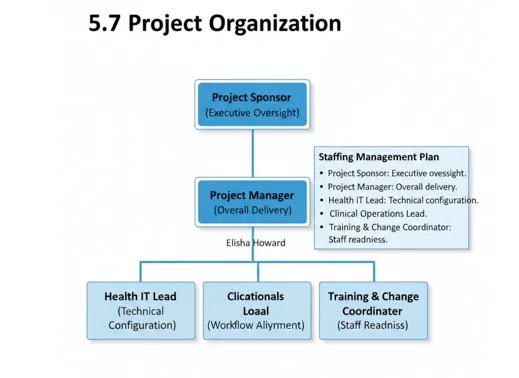
Role | Name/Title | Responsibility |
Project Sponsor | ___ the Strategist | The Strategist gives strategic guidance, funds, and meets hospital objectives. |
Project Manager | Name | Responsible for the project schedule, scope, and communication. |
Health IT Lead | ___ the Technologist | Responsible Technical part of the implementation, integration, and system configuration. |
Clinical Operations Lead | ___ the Organizer | Organizer oversaw the Workflow to fit with the work of the hospital. |
Training & Change Coordinator | ___ the Marketer | Responsible for training staff and taking on the new system. |
Finance Director | ___ the Frugal | Budget and financial control of the project. |
In terms of project management, the Project Manager and Project Sponsor are the most crucial leadership roles in the project structure. The greatest authority lies with the Project Sponsor, as the position ensures that there is strategic alignment between the organizational goals and grants the approval of funding and major project decisions. In the absence of executive sponsorship by the sponsor, project initiatives might not have organizational priority and sufficient allocation of resources. The Project Manager is the key planning position that concentrates on converting strategic goals into action plans. The role of the Project Manager is one that is significant in that the necessary communication between the stakeholders is integrated, project progress is monitored, risks are managed, and that scope, schedule, and cost constraints are addressed. The most crucial technical stakeholder is the Health IT Lead since the know-how of technical implementation is the key to a successful system configuration and integration. In case of failed system integration with the patient database or the network infrastructure of the hospital, the project will not be able to meet its objectives in terms of operations. Regular coordination between the Project Manager and the Health IT Lead further helps ensure that technical milestones remain aligned with the overall project timeline. The operational alignment is critical, and the Clinical Operations Lead can directly influence the schedules of workflow since they have direct implications on physicians, nurses, and administrative staff. This stakeholder makes sure that the new system is based on actual clinical processes and that it assists in making the care of a patient efficient. The Training and Change Coordinator is crucial in the process of user adoption, which can be one of the largest setbacks in implementing healthcare technology. Even the properly designed system can still fail in case the personnel are not adequately trained or oppose the changes in the workflow. Lastly, the Finance Director also offers financial governance to ensure that spending does not exceed the budget and that appropriate financial risks are insured during the entire lifecycle of the project.
6. Authorizations | |
The Project Scope Statement is approved by the: | |
Project Sponsor | Hospital Operations Director |
Project Manager | Name |
Project performance baseline changes will be approved by the: | |
Project Sponsor | |
Project Manager | |
Project deliverables will be approved and accepted by the: | |
Project Sponsor | |
Key Stakeholders | |
7. Project Scope Statement Approval | ||||
Project Name | Implementation of Hospital Patient Scheduling System | |||
Project Manager | Name | |||
This document is aimed at giving a vehicle with which the first planning of the project can be documented. Before much commitment of resources and expenditure is made on the project, it is used to achieve an acceptable degree of mutual understanding between the Project Manager and the Project Sponsors and Owners in terms of objectives and scope of the project. | ||||
I read information in this Project Scope Statement and concur: | ||||
Name | Role | Signature | Date | |
— the Strategist | Project Sponsor | __________________ | __________ | |
— | Project Manager | __________________ | __________ | |
— the Technologist | IT Lead | __________________ | __________ | |
— the Organizer | Clinical Lead | __________________ | __________ | |
— the Marketer | Training & Change Coordinator | __________________ | __________ | |
— the Frugal | Finance Director | __________________ | __________ | |
The signatures in the document above show that those signing the document knew the content and the purpose of this document. Their signature on this document is an agreement to this as the official Project Scope Statement document.
[/blur_section]