

Student Name
Capella University
PM-FPX5018 Project Management Foundations
Professor Name
Submission Date
Table of Contents
Project Scope. 3
Overview.. 3
Description. 3
In Scope. 4
Out of Scope. 4
Acceptance Criteria. 4
Deliverables/Required Work. 5
WBS Introduction. 5
Analyzes AI Usage, Including Clear Descriptions of Prompt Construction. 6
A Robust Rationale Justifying Each Decision. 7
Consideration of Best Practices of AI Use in the Profession. 7
Conclusion. 8
References. 9
Project Scope
Overview
The marketing campaign plan aims to boost Cosmo, Inc.’s market exposure or footprint in the wearable technology industry. The project’s goal is to increase the volume of wearable tech produced to 25% over the previous year, and customers to 20%. The programme will leverage the latest technologies, including data analytics, Internet of Things, mobile technologies, and artificial intelligence (AI) to enhance customer interaction (Mejia et al., 2021). Mr. James will head the team as the manager, and he’ll be working on revamping the marketing strategy and making it more efficient in order to build a competitive edge in the growing wearable technology industry. We will start our campaign on Nov. 1, 2025, through Jan. 15, 2026, and the campaign will cost us $150,000 dollars.
Description
The company finds itself in the midst of a fiercely competitive segment – the wearable technology market – that is starting to erode the market share of Cosmo, Inc. The company will, in turn, apply an innovative marketing approach, involving new technologies and customer segments that haven’t been previously formed. The approach is going to employ predictive analytics, AI, and IoT to facilitate data-based marketing choices and provide more personalized customer experiences (Cheung et al., 2020). Furthermore, the use of mobile technologies will accelerate the company’s penetration into the market, as it can be used for customer engagement. Through the improved marketing, Cosmo will become a leader in the marketplace and will be able to achieve a competitive edge again.
In Scope
The project will focus on creating a robust marketing plan in which the underserved and not targeted customer segment will be targeted. It will involve detailed market analysis and customer base segment analysis using data analytics, and marketing campaigns will be targeted according to AI. The scope of the project will include connecting the IoT and mobile technologies in the systems already in place, and by doing so, ensure a seamless customer experience. Predictive analytics will be another method of honing in on decision-making and increasing customer engagement. In addition, the project will support one another to enhance the customer service processes, which will increase satisfaction and retention.
Out of Scope
It will not be a hardware project, and no changes to the existing wearable devices will be made. It is definitely a marketing strategy-oriented and customer engagement-oriented product, and not a product development & design oriented product. This project will also have no global expansion as it will be targeting a unique group of customers in the current market, which are untapped (Brophy et al., 2021). The project will not address issues related to the value chain, manufacturing, or supply of the products. Moreover, it won’t be a major internal restructuring or change in personnel aside from marketing and customer service.
Acceptance Criteria
The project has some parameters that define a successful project (25% growth in the number of wearables produced, 20% growth in the number of customers, etc.). Another criterion of acceptance will be customer satisfaction, which can also be measured through surveys and feedback on the new approach of personalized marketing. Marketing strategy should be formulated and implemented in the allocated time of 10 weeks, so that all the deliverables are delivered within the allocated time frame (Dehghani et al., 2020). This project should not exceed the budgeted funds of 150000 USD, and a good indication of the payback in the form of income/revenue must be displayed. The real-time tracking and modulations will also be used to assess campaign effectiveness to accomplish desired goals.
Deliverables/Required Work
The optimization of a customer service support process with the aim of improving customer satisfaction and involvement will be a secondary deliverable (Ferreira et al., 2021). The project will also provide the performance tracking system to identify the success of the programme, and can provide a real-time insight into customers’ behaviour. The final report will include a summary of the results of the campaign, lessons learnt, and suggestions for future marketing campaigns. The aforementioned deliverables will ensure that Cosmo, Inc. can not only win the market share but also grow its brand value and customer loyalty.
Deliverables to be performed
The project will result in a detailed marketing program, which will include specific marketing strategies for customer segmentation based on data analytics and predictive modeling. The process of integrating IoT, AI, and mobile technologies into the marketing process will be crucial in the deliverables and will be geared towards enhancing customer engagement and optimizing marketing efforts. Implementing a new customer service process will improve the response time and satisfaction of the customers (Ferreira et al., 2021). Furthermore, the project will provide a fully optimised real-time monitoring and adjustment system, exactly the same as the marketing campaigns, to ensure that the marketing activities achieve the desired production result of 25% increase and customer base of 20% growth. Periodic performance reports will be created to gauge the effectiveness of the campaign and realign campaigns as needed.
Deliverables Not to be performed
The development of new wearable technology products or the changing of the existing technological products will not be part of the project. It will not address expansion or adaptation of products to global markets, since its core is the enhancement of the marketing strategy in the existing markets. Furthermore, the project’s outputs will not include any product manufacturing processes or technical development in wear technology features. This project will not address long-term infrastructure and/or organizational restructuring.
Constraints, Dependencies, and Assumptions
The project has a limited time – six months to conduct the marketing campaign and a maximum budget of $150,000. Dependencies include the cooperation and support of multiple departments, marketing, IT, financial, and customer service, and the set-up of necessary technological infrastructure on time, which includes data analytics and mobile technology solutions. Assumptions involve that there will be sufficient human resources and budgets, and that new technology is integrated with existing technology. Also, data analytics are assumed to be able to predict customer behavior accurately.
Mitigation Strategies
The project will be continuously monitored, with real-time feedback to make adjustments to the project to reduce the risks of having such a tight time frame. Where there is a delay in the integration of technology or staff resistance to new technology, then extensive staff training and support will be provided. The marketing team will make adjustments to the tactic depending on any feedback from the customers and the performance of the campaign in real-time to ensure that the appropriate target audience is being reached. Working to resolve any technical problems with the integration of new technology into existing systems through regular testing and proactive IT support will help alleviate these concerns.
Work Breakdown Structure (WBS)
WBS Introduction
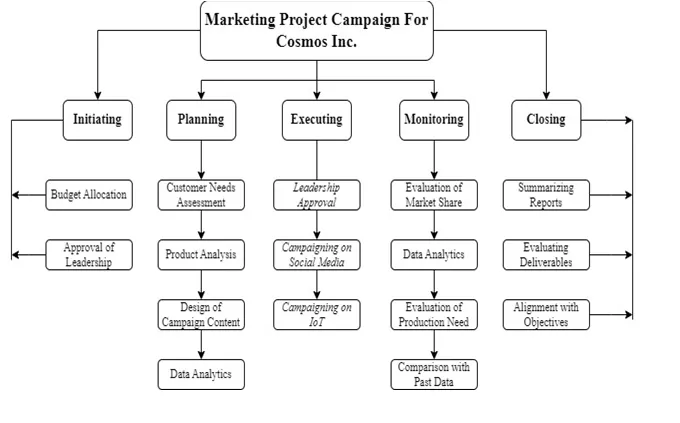
Work Breakdown Structure (WBS) is a key planning and controlling tool of a project. It is also used to break the project down into smaller and manageable tasks, to ensure all the activities are identified and assigned to the correct people. In the Cosmo, Inc. marketing promotion case, WBS will provide all the stages of the case, starting with the market analysis and customer service advancement, explaining all the activities that will lead to a successful implementation of the project (Tikkanen et al., 2023). This structured breakdown also supports better coordination among the various departments involved in the project. It can be helpful in setting clear project objectives, outcomes, schedule, and allocation of project resources. It’s also easy to track progress and keep an eye on it since the WBS allows the project to be kept on track and within budget.
WBS Graphical Representations
Analyzes AI Usage, Including Clear Descriptions of Prompt Construction
The application of AI within the Cosmo project is going to be based on data analytics, predictive modeling, and customer segmentation to develop a better marketing campaign. The first step towards implementing AI is the ability to construct effective prompts that are clear and precise, and will ensure the AI models being trained are effective (Verma & Tandon, 2022). The AI system could provide valuable input by defining some of the goals and variables, like the preferences of customers, market trends, and so on. Specified marketing approaches will be designed using the above insight, and this will make the marketing activities of Cosmo efficient and effective. It’s vital to make sure that a construction is clear and time-sensitive decisions are made to achieve the desired results.
Systematic Evaluation, Iterative Refinement, Explicit Manual Revisions
Some systematic evaluation of the AI products should be carried out to ensure that the outcomes are in line with the project objectives. After creating the initial insights, the refinement process is repeated until the accuracy of the AI models is improved. It involves continuously validating and adjusting the AI forecasts based on actual data while making necessary adjustments. There might be a need to have explicit manual revisions so as to counter any discrepancy or to make the model responsive to any emerging trends (Cheung et al., 2020). The strategy will ensure the marketing campaign is customer-centric and any AI decision will be pertinent and valuable.
A Robust Rationale Justifying Each Decision
Each decision made on integrating AI should be well-explained to determine whether it is part of the marketing process. This includes choices surrounding the kind of technology to use, selections of the customer audience to target, and how to use data analytics. It will be based on detailed market analysis, probable return on investment of the use of AI tools, and the gains to be achieved if it uses specific strategies. For example, segmenting customers based on AI has been seen to provide a more personal and effective focus on marketing, increasing customer interactions and sales. These decisions can be justified to promote transparency and accountability, enabling the stakeholders to appreciate the worth of a particular decision taken.
Consideration of Best Practices of AI Use in the Profession
Best practices for AI use in the workplace boil down to transparency, uniformity, and enhancement. The best way to utilize AI is to make sure the professionals provide the AI models with specific and precise prompts so as to obtain good and relevant results. It is important to consistently monitor and update AI systems to keep them in line with business objectives. Furthermore, ethical behaviour by professionals must be the norm, so that privacy and security of data, especially when involved with customer data (Bianchi et al., 2022), are maintained.
Conclusion
The developed marketing campaign strategy for Cosmo, Inc. will focus on modern technologies such as AI, IoT, and data analytics, improving consumer engagement and strengthening the market foothold. The project expects to give a 25% increase in productivity and 20% more customers, offering a competitive edge among opponents in the wearable technology market. The combination of these forms of Artificial Intelligence will give a valuable assessment that will improve and evolve with time to serve as a foundation for the marketing strategies and customer engagement efforts. Proper justification of the project activities indicates a concentrated alignment with the corporate goals. This project will definitely increase Cosmo’s efficiency in operations and help strengthen Cosmo’s position as a leading wearable technology Company.
References
Bianchi, C., Tuzovic, S., & Kuppelwieser, V. G. (2022). Investigating the drivers of wearable technology adoption for healthcare in South America. Information Technology & People. https://doi.org/10.1108/itp-01-2021-0049
Brophy, K., Davies, S., Olenik, S., Çotur, Y., Ming, D., Van Zalk, N., O’Hare, D., Güder, F., & Yetisen, A. (2021). The future of wearable technologies. The Future of Wearable Technologies, 6. https://doi.org/10.25561/88893
Cheung, M. L., Leung, K. S. W., & Chan, H. S. (2020). Driving healthcare wearable technology adoption for Generation Z consumers in Hong Kong. Young Consumers, ahead-of-print(ahead-of-print). https://doi.org/10.1108/yc-04-2020-1123
Dehghani, M., Abubakar, A. M., & Pashna, M. (2020). Market-driven management of start-ups: The case of wearable technology. Applied Computing and Informatics, ahead-of-print(ahead-of-print). https://doi.org/10.1016/j.aci.2018.11.002
Ferreira, J. J., Fernandes, C. I., Rammal, H. G., & Veiga, P. M. (2021). Wearable technology and consumer interaction: A systematic review and research agenda. Computers in Human Behavior, 118. https://doi.org/10.1016/j.chb.2021.106710
Mejia, C., Ciarlante, K., & Chheda, K. (2021). A wearable technology solution and research agenda for housekeeper safety and health. International Journal of Contemporary Hospitality Management, ahead-of-print(ahead-of-print). https://doi.org/10.1108/ijchm-01-2021-0102
Tikkanen, H., Heinonen, K., & Ravald, A. (2023). Smart wearable technologies as resources for consumer agency in well-being. Journal of Interactive Marketing, 58(2-3). https://doi.org/10.1177/10949968221143351
Verma, B., & Tandon, U. (2022). Modelling barriers to wearable technologies in the Indian context: Validating the moderating role of technology literacy. Global Knowledge, Memory, and Communication. https://doi.org/10.1108/gkmc-08-2022-0209