

Student Name
Capella University
PM-FPX5018 Project Management Foundations
Professor Name
Submission Date
Table of Contents
Title. 1
Table of Contents. 2
Executive Summary (Assessment 4) 3
Project Charter (Assessment 1) 4
Business Need. 4
Project Objectives. 4
Approach. 4
Initial Risk Factors. 4
Regulatory Costs/Impacts. 4
Roles and Responsibilities. 4
Project Scope (Assessment 2) 6
Overview.. 6
Description. 6
Work Breakdown Structure (WBS) (Assessment 2) 6
Project Management Cost (Budget) (Assessment 3) 7
Introduction (Intent): 7
Project Budget: 7
Project Management Schedule (Assessment 3) 8
Introduction (Intent): 8
Microsoft Project Document: 8
Risk Management Plan (Assessment 4) 9
Risk Matrix. 9
Project Quality Plan (Assessment 4) 10
Project Close and Lessons Learned (Assessment 4) 11
Appendices. 12
References. 13
Executive Summary (Assessment 4)
Project Charter (Assessment 1)
Project Title: Cosmo Marketing Campaign Technology Integration Project
Project Start Date: January 20, 2026
Projected Finish Date: April 24, 2026
Budget Information: $150,000
Project Manager: Tina Walker
Business Need:
Such a loss of market share cannot be sustained, and thus urgent strategic measures must be considered so that the company can sustain its competitive positioning and organizational viability. 33 percent of the market is in jeopardy of slipping from the company Cosmo, Inc., as new companies enter the market and new technology becomes available. There is a direct relation between proactive marketing innovation and customer retention and the sustainable competitive advantage in the technology sectors (Almrshed et al., 2023). This is also in line with the organizational objectives in regard to the expansion of market share by twenty per cent and interaction with customers.
Project Objectives
This project will be realized through a holistic marketing effort, based on technology, aimed at improving market share and customer acquisition.
- Create and implement a marketing campaign using social media and data analytics as an integral component in it, and engage in the sausage-making process, targeting specific identified customer segments.
- Integrate IoT and mobile technology with the current ERP and marketing systems for a better customer experience.
- To design processes and implement support systems to meet the growing demand and address questions about the products.
Approach
Structured management systems and systematic methods ensure successful project execution that enables the alignment of deliverables and customer expectations. For this project, Gantt charts, risk registers, and stakeholder communication plans will be developed. Systematic project management practices can help to reach the project implementation goals and reduce scope creep of technology-related initiatives (Javid et al., 2025). Continuous control coupled with flexible planning will be used to achieve deadlines in all project phases while assuring quality.
Assumptions:
- The given budget of $150,000 will not change or be set aside for other project costs.
- Cross-functional team members (Marketing, IT, Finance, and Customer Service) will ensure that time is dedicated.
- Team members will be on call for about 20 hours a week for project activities.
- There are industry and company best practices and standards within the existing ERP System and the technical infrastructure to ensure that new integrations will be supported.
- Inadequate interoperability of the current IT systems for the data analytics and the IoT platform implementations.
- Top management will provide support and commitment for the 10-week duration of the project (Wiewiora and O’Connor, 2022).
- There will be no major changes to the organization during the implementation of the project.
- Collaborative partnerships will remain, and technology platforms will be sustained.
- The customer demographic data is accurate and reflects the desired target market segments.
Constraints:
- The compressed project timeframe (10 weeks) does not give time for going into detail for extensive customization options.
- In order to save the $150,000, one must choose from limited vendors, limited technology platforms, and a limited training program scope.
- Due to budgetary constraints, sequencing of deliverables and optimization of resources need to be considered and prioritized
- € Limited access to IT expertise (such as IoT experts, mobile developers, data engineers)
- Not possible to replace the existing ERP infrastructure- Only able to integrate with the new ERP systems
- Marketing campaign must be in line with all data privacy laws, such as GDPR, CCPA, COPPA, etc.
- Customer service team does not have the capacity to have training sessions that go too long (Pourrahimian et al., 2025)
- Techno-Disruption should not cause disruption in current business operations
- 10 business days max per project task will be completed.
Dependencies:
- The implementation of IoT is hindered by the need for IT infrastructure upgrades to be completed.
- All technology purchasing should be done within the guidelines of the Finance department budgetary approvals.
- Note: Platform subscription starts after vendor contract negotiations and approvals are made.
- Third-party engagements require legal review and approval of contracts.
- To create marketing content, companies need to have a complete social media strategy.
- Successful completion of technology platform testing and validation (Kalleparambil et al., 2024) is required to launch a campaign.
- Training for staff relies on the completion of training materials development
- It takes a data analytics platform to be fully functional to set up a performance dashboard.
Initial Risk Factors
Cataloging risks is essential for organizations, as this allows the organization to take steps to mitigate risk before it disrupts the success of the project by causing delays. Technology integration failure is a serious risk as it can threaten the launch and impact projected customer engagement negatively by 15 to 20 percent. By using a comprehensive risk management model, project success is more likely because it helps identify weaknesses and allows for the development of contingency plans (Firoozi and Firoozi 2024). Risk mitigation for this project involves the addition of a backup vendor, reserving 10 percent of the budget for contingencies, and pilot testing the project.
Labor shortages are a significant risk that can worsen the quality and lead to the project crossing the unacceptable limits of time and scope. The various members of the cross-functional project team are likely to have competing priorities, which will lead to a lack of commitment to the project (Marketing, IT, Finance, and Customer Service). Conflicting priorities of team members and competing resource requests are among the most common causes of delays and changes in the project scope (Nishaant et al . 2025). Resource sponsorship rings, cross-training for operational continuity, and remote working options are among the risk mitigation strategies.
Regulatory Costs/Impacts
Regulatory compliance adds pressure on budgets, schedules, and ways of doing business that must be considered for planning and allocation of resources. Compliance with laws such as GDPR, CCPA, and COPPA creates burdens for implementing privacy of data, management of consent, and litigation of compliance. Digital marketing laws make operating in this space more complicated and costly, as knowledge of laws in certain areas is a prerequisite for implementation (Serhan and Zhang, 2025). The cost of compliance is pegged at 15 percent of the project budget, and estimates for legal and technology assurance are included.
In the distribution and delivery of advertising content, restrictions by the Federal Trade Commission (FTC), advertisement standards, and net neutrality create a layer of compliance. The cost of compliance and restrictions on operation can reduce the effectiveness of a campaign and can detract from the image of the organization. Regulation adherence frameworks limit legal liability and do not compromise ethics in marketing and foster consumer confidence (Sharma and Sharma, 2024). Mitigation can be automated through compliance with monitoring reviews, and/or legal counsel in campaign design.
Roles and Responsibilities
Role | Name | Organization and Position | Responsibilities / Tasks on the Project | Contact Information |
Project sponsor | Harold Living | Cosmo, Inc., CEO and President | Provides executive authorization, secures funding, removes organizational barriers, approves major deliverables, and scope changes. | |
Project manager | Tina Walker | Cosmo, Inc., Project Management Office | Oversees project execution, manages resources and timeline, coordinates cross-functional teams, monitors risks, ensures deliverable quality, and budget compliance. | |
Marketing Lead | Sarah Chen | Marketing Department, Director of Digital Marketing | Develops campaign strategy, manages social media initiatives, oversees content creation, analyzes customer segmentation data, and reports on campaign performance metrics. | |
IT Lead | Michael Rodriguez | Information Technology Department, IT Systems Manager | Implements technology integrations, manages ERP system modifications, ensures IoT and mobile platform functionality, provides technical support, and performs infrastructure maintenance. | |
Finance Lead | Jennifer Thompson | Finance Department, Financial Analyst | Manages project budget allocation, tracks expenditures, provides cost analysis reports, approves vendor payments, ensures financial compliance, and ensures reporting accuracy. | |
Customer Service Lead | David Park | Customer Service Department, Customer Service Manager | Develops new support processes, trains service representatives, implements customer feedback systems, and manages service quality metrics and customer satisfaction tracking. |
AI Use Analysis
To keep the outputs relevant, I created a tailored prompt for each section of the Project Charter, using the AI tool from the Coursera course. Features of the tailored prompt included requirements for a first draft with a word count limit, an academic tone, and the inclusion of Cosmo case details. I included the AI feedback in the evaluation, along with the answer’s alignment to the assignment rubric, citations, and relevance to the organization. I adjusted and added prompts based on the AI’s requirements for response length and adjusted the tone based on formality. This iterative process reinforced the value of combining AI efficiency with human judgment for quality assurance. I had to improve the content by manually editing and revising. This included providing details on the stakeholders, structuring the content to identify the sections for the client, assessing citations for the APA style, and providing context for Cosmo’s market position, which I had to source externally. The AI usage best practices include: using AI tools for drafting, not content creation; always fact-check and verify sources; maintain a critical mind when using AI; have a sound knowledge of the topic; and respect ethical standards.
Project Scope (Assessment 2)
Overview
Well-defined project scopes can provide boundaries for resource allocation, stakeholder expectations, and the successful completion of deliverables. Cosmo, Inc. needs tech-based marketing campaigns in order to recapture the 33% of the market it is losing each year to be able to compete rather than simply survive. It is observed that articulating project scope leads to better project performance, reduced scope creep, and improved stakeholder satisfaction (Ahmed and Jawad, 2022). This initiative is delivering customer acquisition and improved technology and market positioning in the growing wearable technology market.
Description
All steps of the data-driven marketing campaign design process will be included in the project’s scope. This will include tools and applications related to data analytics, social media, the IoT, and mobile technologies. During the 10-week project, the final deliverables for the organization, within this scope, will be marketing strategy reports, a technology integration strategy, enhancements to the customer service process, and performance monitoring dashboards. As stated by Varajao et al. (2024), a precise scope statement clarifies the intent of the project and maintains focus by controlling scope creep. The intended participants are from the Marketing, Information Technology, Finance, and Customer Service departments. The data will be extracted from customer relationship management systems, social media analytics, and enterprise resource planning systems.
In scope: Developing and deploying social media campaigns, deploying data analysis platforms, integrating IoT and mobile technology into existing ERP systems, developing customer service processes and training, monitoring performance measures, and demographic segmentation analysis of the 25-50-year-old demographic.
Out of scope: Any changes in the product design, any change in the manufacturing process, campaigns to the international market, manufacturing of hardware, change of the complete ERP system, and any other things outside of 6 months campaign and a 150000 € budget were considered out of scope.
Acceptance Criteria:
To maximize the chances of success for the project, measurable results must align with performance metrics describing the impact of the project on stakeholders. The focus of the marketing campaign will be individuals who fall within the 500,000 users of the target demographic, with the goal of increasing the number of users by 20% over the defined period, and increasing the capacity of the wearable device by 25%. If established acceptance criteria are defined well, the project will be evaluated objectively, and the project is likely to be closed within agreed timeframes (Sakka et al, 2023). Other project attributes include a functional Data Analytics Dashboard that provides customer segmentation on a weekly basis, a customer service response time of 24 hours or less, and proof of compliance of all processed data with GDPR and CCPA Data Protection Laws.
Quality of the deliverables and final approval from project stakeholders (executive sponsor, Harold Living, project manager, heads of the respective departments of Marketing, IT, Finance, and Customer Service) will be guaranteed. Strong team and project success require leadership qualities of clear communication, sound decision-making, and constructive problem-solving (Azlan et al., 2024). Implementation of project management with strategic leadership that includes transparent and accountable, and cross-functional cooperative leadership styles increases project Stakeholder participation and decreases project conflict, and fosters timely problem resolution. It implies that leaders should take timely action and make appropriate critical project decisions in order to avoid the effects of scope creep both on the project and on project success.
Deliverable(s):
Project Deliverables must meet the project scope and provide measurable value to stakeholders. The project entails developing a complete Social Media Marketing Plan, an Integrated Data Analytics Platform, the integration of IoT technology, Customer Service Training Content, Campaign Performance Reports, and Digital Content (Advertisements and Social Media Posts). Well-defined project deliverables foster accountability and help monitor progress and quality control throughout project execution (Alotaibi et al., 2025). Project deliverables not included in the scope are new product designs, manufacturing equipment purchase, physical infrastructure changes, International Marketing materials, a complete System Replacement, and any project with a budget over $150,000 or a timeline exceeding 10 weeks.
Constraint(s):
- Due to the short project duration (10 weeks), there are limited possibilities for many customization variants, and conversely, these approaches to the sequencing and optimization of resources must be given greater weight.
- The budget constraint of a static number of 150,000 is restricting its range of vendors, even the platform of technology being used, and preventing it from carrying out extensive training programs at all levels of the organization.
Dependencies:
- After that, updates of the IT infrastructure and system compatibility tests can be performed, and the implementation of data analytics platforms and the IoT can begin.
- No approvals of budgets of the finance department and contracts with third-party service providers should be given without the commencement of technology procurement, platform subscriptions, and engagements.
Assumption(s):
- The time of the participants (members of the cross-functional team) will be dedicated without any priority conflicts, as marketing, IT, finance, and customer service will spend the necessary time to accomplish the requested tasks.
- ERP systems and technical infrastructure available have enough capacity and compatibility to support new data analytics and IoT integrations.
Mitigation Strategies:
- All members of each team will be expected to attend and fully commit to the same degree. Executive sponsorship will determine the order of resource allocation to conflict addressing projects and interdepartmental project conflicts.
- Resources will be assessed through the executive sponsorship, and the eligibility of projects and addressing interdepartmental conflicts will be prioritized.
Work Breakdown Structure (WBS) (Assessment 2)
WBS Introduction:
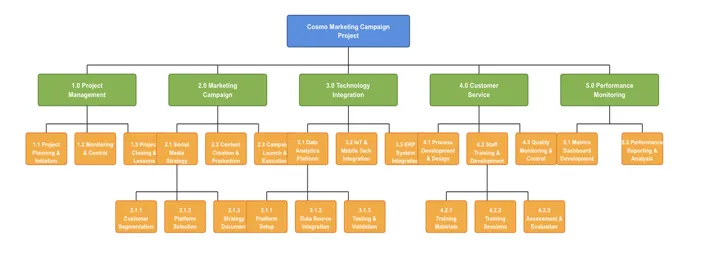
Work breakdown structures (WBS) break projects into smaller parts and help allocate people to different sections to monitor progress. In the case of the Cosmo marketing campaign, the WBS is designed around five project management components (deliverables) – marketing, technology, customer service, and performance. According to Naderi et al. (2024), a good WBS design will improve the estimation accuracy of cost, scheduling, and assignment of accountability during project execution. It will allow the work packages to be structured to cover all the elements of the project scope and be clear about where accountability and responsibility of the work lies within the organization.
WBS Graphical Representation(s):
AI Use Analysis
For the Project Scope and Work Breakdown Structure, I designed prompts and instructed the AI to use a scholarly tone. I used the Coursera AI to help generate the document. To evaluate AI feedback, I examined the assessment rubric to identify project scope items and out-of-scope items, then applied PMI to the WBS hierarchy. I also ensured that the citations and references adhered to APA format. One key requirement was manually adjusting the WBS. This included restructuring the WBS to include the four departments of Cosmo (Marketing, IT, Finance, and Customer Service), as well as limiting the project budget to $150,000 and the project timeframe to ten weeks. This also required adjusting the initial diagrams and adding acceptance criteria that could not be determined by AI, such as “growth of 20% customer base.”
Project Management Cost (Budget) (Assessment 3)
Introduction (Intent):
Budgeting determines the financial viability of a project. It allows for the proper allocation of resources during the lifespan of a project to deliver the intended outputs. The Cosmo marketing campaign will require an extensive labor, technology, marketing, and training expenditure analysis, as well as an analysis of other expenditure that totals 150,000. Overspending and financial threats will be limited by the application of systematic cost control procedures such as bottom-up estimating and developing contingencies (Tombari et al., 2024). The budgeting model is designed to be strategic, with respect to goal-oriented within financial limitations, accountable, fiscally responsible, and investment-focused.
Project Budget:
WBS Code | Task/Deliverable | Cost Category | Estimated Cost | Priority Level |
1.0 | Project Management | $18,000 | High | |
1.1 | Project Planning & Initiation | Labor | $5,000 | High |
1.2 | Project Monitoring & Control | Labor | $10,000 | High |
1.3 | Project Closing & Lessons Learned | Labor | $3,000 | High |
2.0 | Marketing Campaign Development | $42,000 | High | |
2.1 | Social Media Strategy Development | Labor/Consulting | $12,000 | High |
2.2 | Content Creation & Production | Marketing | $18,000 | High |
2.3 | Campaign Launch & Execution | Marketing | $12,000 | High |
3.0 | Technology Integration | $52,000 | High | |
3.1 | Data Analytics Platform Implementation | Technology/Software | $25,000 | High |
3.2 | IoT & Mobile Technology Integration | Technology/Software | $20,000 | High |
3.3 | ERP System Integration | Technology/Software | $7,000 | Medium |
4.0 | Customer Service Enhancement | $16,000 | Medium | |
4.1 | Process Development & Design | Labor/Consulting | $5,000 | Medium |
4.2 | Staff Training & Development | Training | $8,000 | Medium |
4.3 | Quality Monitoring & Control | Technology/Software | $3,000 | Medium |
5.0 | Performance Monitoring | $8,000 | Medium | |
5.1 | Metrics Dashboard Development | Technology/Software | $5,000 | Medium |
5.2 | Performance Reporting & Analysis | Labor | $3,000 | Medium |
Contingency Reserve (10%) | Risk mitigation and unexpected costs | Contingency | $14,000 | Medium |
TOTAL PROJECT BUDGET | $150,000 |
Budget Category Summary
Budget Category | Total Cost | Percentage of Budget | Priority |
Labor | $36,000 | 24% | High |
Technology/Software | $60,000 | 40% | High |
Marketing | $30,000 | 20% | High |
Training | $8,000 | 5% | Medium |
Consulting | $17,000 | 11% | High |
Subtotal | $136,000 | 91% | |
Contingency Reserve | $14,000 | 9% | Medium |
TOTAL | $150,000 | 100% |
Budget Comments
Cost estimation is a complicated task, involving many parts, such as understanding market rates and knowing how constrained resources and project costs affect the organization’s bottom line. The Cosmo marketing campaign budget allocates 32,000, 10,000, and 10,000 to the work breakdown structure elements: technology integration, marketing development, and marketing objectives, respectively. The bottom-up approach and parametric models are some of the best cost estimation methods, which reduce financial risks and increase budget accuracy (Tombari et al., 2024). A contingency fund of 14,000 (10 percent) will absorb some of the risks of budgeting, in case unanticipated events happen. This way, the financial targets are met without requiring further approvals from the executive team.
Project Management Schedule (Assessment 3)
Introduction (Intent):
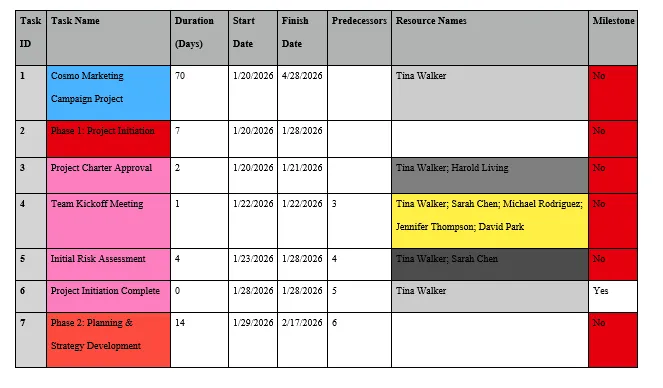
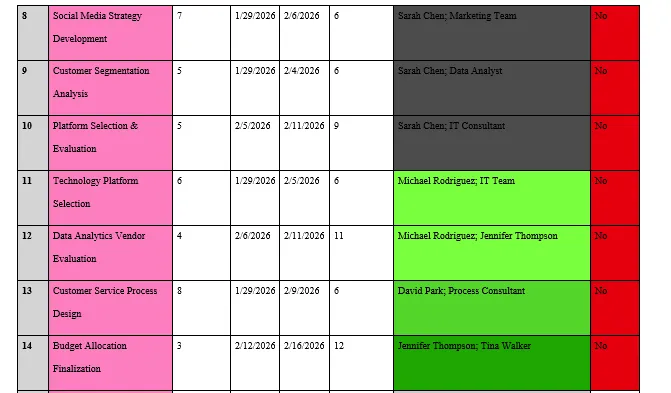
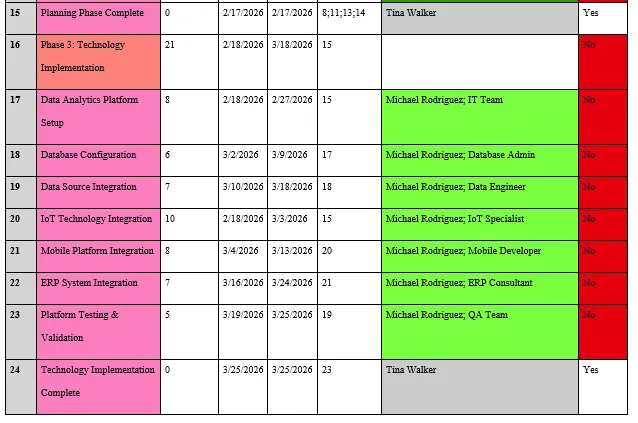
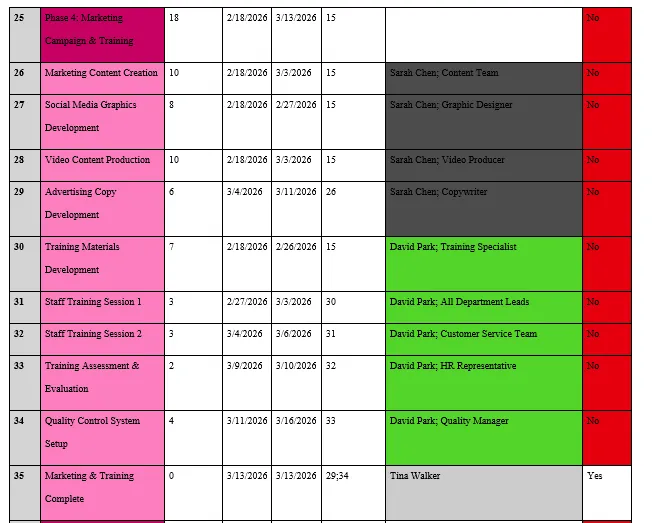
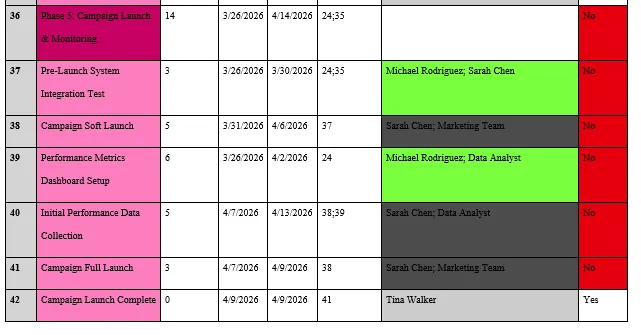
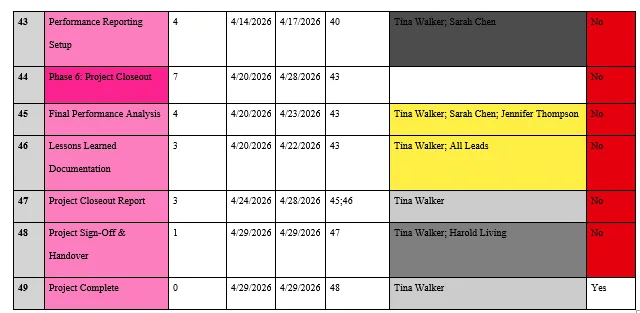
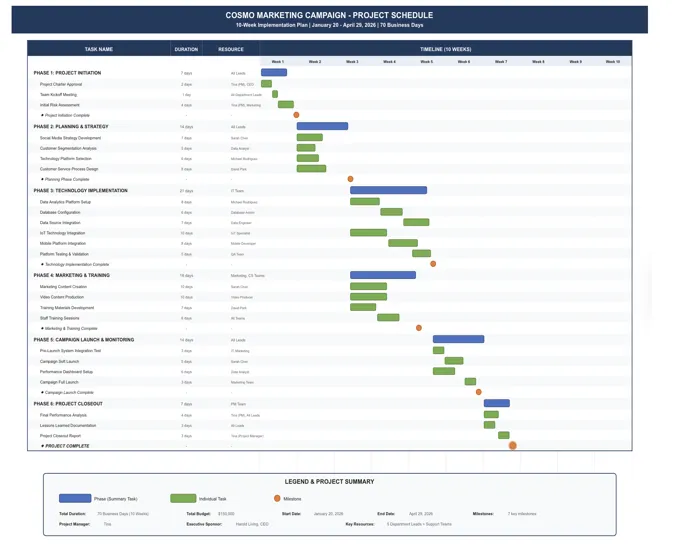
A comprehensive project schedule provides details about how to track project progress, how resources will be allocated, how monitoring will be done, and when key deliverables will be produced. The implementation of the Cosmo marketing campaign will occur in a phased implementation over 10 weeks (70 business days), according to the work breakdown structure, which outlines the milestones. Time management will be a key focus to drive the project towards completion on time and establish controls to mitigate potential delays (Zhu et al., 2022). Through a visual representation of the detailed project timeline, effective communication with stakeholders will occur, ensuring optimum resource utilization and project accountability at all implementation process stages of the project.
Microsoft Project Document:
AI Use Analysis
I also interacted with the course room AI tool to assist me in the process of creating a budget and schedule by writing long prompts that required the procedures to create cost estimates, models for budget classification, and budget scheduling best practices using the PMI standards and the possibly restricted US dollar budget of 150,000 USD. AI answers were assessed by comparing them to the criteria on the assessment rubric, comparing the cost suggestions to their industry equivalents, checking that the schedule suggestions did not exceed the 70-day requirement, and checking the literature cited in the APA format. AI application across professions is best done by independently validating all numerical calculations and schedule dependencies and critically evaluating the monetary and rational validity of the output. AI should be treated as a tool for conceptual generation and not for end product development. There should be a retention of human judgment in the strategic decision-making around budget and resource allocation, as these cannot be made independently through AI. This approach reflects original analytical thought and the ability to customize in a given context.
Risk Management Plan (Assessment 4)
Introduction:
Risk Matrix
Introduction and Legend (Intent):
Risk Description | Probability (L, M, H) | Impact (L, M, H) | Risk Owner | Risk Response (Mitigation) |
Project Quality Plan (Assessment 4)
Introduction (Intent):
Plan Quality Management Processes:
Inputs:
Tools and Techniques:
Outputs:
Manage Quality Assurance:
Inputs:
Tools and Techniques:
Outputs:
Control Quality:
Inputs:
Tools and Techniques:
Outputs:
Project Close and Lessons Learned (Assessment 4)
Appendices
…..
References
Ahmed, R., & Jawad, M. (2022). Avoiding or disregarding: Exploring the relationship between scope creep, project complexity, and the success of construction projects. Project Leadership and Society, 3(1), e100064. https://doi.org/10.1016/j.plas.2022.100064
Almrshed, S. K. H., Tuckova, H. M. J. Z., & Hassan, A. S. (2023). The effect of innovation management on sustainable competitive advantage in contemporary organizations. Journal of Law and Sustainable Development, 11(11), e1980–e1980. https://doi.org/10.55908/sdgs.v11i11.1980
Alotaibi, R., Sohail, M., & Soetanto, R. (2025). Determining project control system effectiveness in construction project delivery. Engineering Construction & Architectural Management. https://doi.org/10.1108/ecam-04-2024-0529
Azlan, O. S., Burhan, I. M., Johdi, S. M., & Suhailawaty, M. S. S. (2024). School leaders’ leadership practices and their influence on crisis-related problem-solving and decision-making: A multi-site case study. IIUM Journal of Educational Studies, 12(1), 50–73. https://doi.org/10.31436/ijes.v12i1.515
Firoozi, A. A., & Firoozi, A. A. (2024). Risk management and contingency planning. Springer Nature Switzerland, 73–80. https://doi.org/10.1007/978-3-031-71097-1_9
Javid, M., Umer, M., Attiq, S., & Munir, A. (2025). Impact of scope creep and process conflict on project success: Moderating role of building information modelling (BIM). Journal of Asian Development Studies, 14(1), 1768–1784. https://doi.org/10.62345/jads.2025.14.1.141
Kalleparambil, S. A., Mekala, S., Ibrahim, A., & Granata, M. M. (2024). Maximizing efficiency: Centralized project material management for owner operators in oil and gas. Abu Dhabi International Petroleum Exhibition and Conference. https://doi.org/10.2118/222760-ms
Naderi, M., Nazari, A., Shafaat, A., & Abrishami, S. (2024). Enhancing accuracy in construction overhead cost estimation: A novel integration of activity-based costing and building information modelling. Smart and Sustainable Built Environment. https://doi.org/10.1108/sasbe-07-2023-0180
Nishaant, H., Sudhakumar, J. N., & Chellappa, V. (2025). Identifying resource allocation challenges in multiproject environments in the construction industry. Journal of Legal Affairs and Dispute Resolution in Engineering and Construction, 17(3). https://doi.org/10.1061/jladah.ladr-1273
Pourrahimian, E., Hamzeh, F., & AbouRizk, S. (2025). Exploring the characteristics of an effective project control method. Lecture Notes in Civil Engineering, 821–832. https://doi.org/10.1007/978-3-031-84208-5_63
Sakka, A., Kourjieh, M., & Kraiem, I. B. (2023). An IT project’s conceptual model to facilitate upstream decision‐making: Project management method selection. International Transactions in Operational Research. https://doi.org/10.1111/itor.13231
Serhan, T. F., & Zhang, S. (2025). The paradox of digital marketing: Sustainable framework for effective strategies and regulatory challenges. Information Development. https://doi.org/10.1177/02666669241303451
Sharma, A. K., & Sharma, R. (2024). Navigating compliance and regulations in marketing analytics: Uph…: Ingenta Connect. Ingentaconnect.com. https://www.ingentaconnect.com/content/hsp/ama/2024/00000010/00000001/art00009
Tombari, A., Nuan, I., Solanke, N. B., & Oziegbe, H. (2024). Development and implementation of cost control strategies in oil and gas engineering projects. Global Journal of Advanced Research and Reviews, 2(1), 001-022. https://doi.org/10.58175/gjarr.2024.2.1.0028
Varajão, J., Lopes, L., & Tenera, A. (2024). Framework of standards, guides, and methodologies for project, program, portfolio, and PMO management. Computer Standards & Interfaces, 92, e103888. https://doi.org/10.1016/j.csi.2024.103888
Wiewiora, A. M., & O’Connor, P. J. (2022). Not all project ambiguity is equal: A typology of project ambiguity and implications for its management. International Journal of Project Management, 40(8), 921–933. https://doi.org/10.1016/j.ijproman.2022.10.005
Zhu, H., Hwang, B.-G., Ngo, J., & Tan, J. P. S. (2022). Applications of smart technologies in construction project management. Journal of Construction Engineering and Management, 148(4). https://doi.org/10.1061/(asce)co.1943-7862.0002260