
Student Name
Capella University
MBA-FPX5016 Operations Management for Leaders
Professor Name
Submission Date
[blur_section id=”postinstructions” button=”Free Download” form_id=”fdfac57″]
Slide: 1
Wild Dog Coffee Company Supply Chain Management Plan provides a strategy to move goods, services, and information throughout the company’s operations as they enter their expansion.
Slide: 2
Supply Chain Management Plan
A good supply chain is crucial in meeting the targets when the company is trying to provide high-quality products, have satisfied customers, as well as reduce costs. This strategy will introduce different designs of supply chain, recommend one suitable supply chain, and debate key logistics issues that can support the efficiency of operations and be flexible. The solution supply chain strategies will ensure that existing and future destinations have a seamless operating system to deliver a consistent supply of high-quality products to meet customer demand.
Slide: 3
Supply Chain Analysis for Wild Dog Coffee Company
Wild Dog Coffee Company is a locally based business and plans to start up another point of operation. The business was founded around the main product, which is espresso drinks, and to keep the quality of the products offered and deliver them on time, it was necessary to have an accurate supply chain (Lavorato & Piedepalumbo, 2023). The coffee shop is dependent on certain inputs such as beans used to prepare the espresso, milk, and flavoring in the beverage, paper cups, lids, and sleeves. There is a need to analyze the supply chain to make sure that both locations can run well without hiccups in the movement of vital ingredients, especially given that an out-of-stock scenario would lead to the shutdown of the business, especially for the espresso beans. In addition, the espresso machines will be serviced twice a month, and the outsourced company will have to work with the maintenance company to ensure the smooth running of the machines and ensure they are well-maintained.
Slide: 4
Centralized Supply Chain
Slide 5:
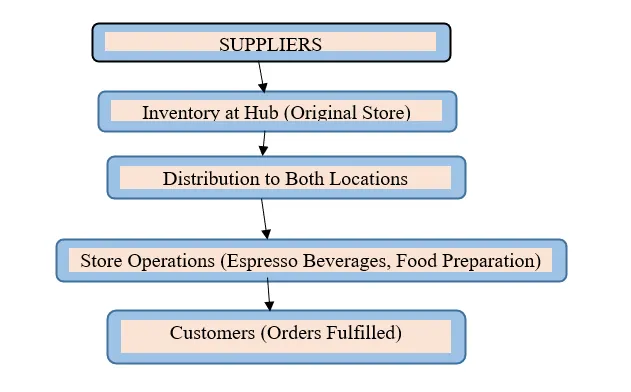
Figure 1: Centralized Supply Chain
Inputs: Espresso beans, milk, flavoring, cups, lids, sleeves, barista time, maintenance services.
Outputs: Espresso beverages, waste materials (empty containers, used filters).
Slide: 6
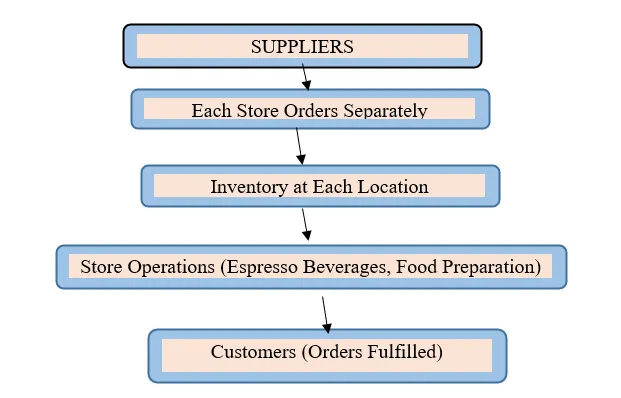
Figure 2: Decentralized Supply Chain
Inputs: Espresso beans, milk, flavoring, cups, lids, sleeves, barista time, maintenance services.
Outputs: Espresso beverages, waste materials (empty containers, used filters).
Outputs: Espressed coffee, foam, cups, lids, sleeves, barista time, maintenance services.
Input: Beans (coffee or tea), water.Output: Espresso beverages, waste materials (empty containers, used filters).
When considering the centralized or decentralized supply chain of Wild Dog Coffee Company, there are multiple aspects to consider. A centralized supply chain can result in saving money and easier management of the inventory through centralization of procurement activities (Petersen et al., 2020). The danger of supply type outs to both destinations is a deep dread, though, given that there would be a business closure if there were a shortage of espresso beans. But a decentralized supply chain is more flexible and more resilient, as each location will be able to run its own supply chain, without a risk of shutdown because of missing supplies. Nonetheless, it can be in conjunction with higher procurement expenses and logistics. To prevent this, it tries to avoid it by applying total productive maintenance (TPM), in which the routine maintenance activities are integrated into daily work, so that it is not necessary to rely on third parties, and the activities are carried out with efficiency.
Also, shipping delays in the logistics of getting the commodity into the individual locations introduce bottlenecks, particularly in cases where the demand for the commodity at one place is higher than the supply. Distribution requirements planning (DRP) was one useful tool that was used to counter this problem, as it assisted in the prediction of demand in all locations and the optimization of inventory distribution (Koripalli, 2025). Finally, ineffective inventory controls and management bring about surplus inventory or stockouts. The impetus of supply chain management (SCM) software will be able to observe the inventory level in real-time and forecast demand; managers can keep ahead of the curve to make an easier flow of goods. With the tools, Wild Dog Coffee will be in a position to reduce supply chain bottlenecks and enhance operations.
Slide: 7
Supply Chain and Logistics Analysis
Value creation is critically dependent on the supply chain and logistics, due to the efficiency in delivering products and services at the right time, right quality, and to customers on time. For Wild Dog Coffee Company, the supply chain needs to be streamlined so that the ingredients, including espresso beans, milk, and flavor agents, are available when needed, and regional issues are removed from the equation. Of importance in this situation, logistics is involved in the delivery of the items on time to the two locations. Inventory control will help the company to reduce wastage and expenses as only fresh products are utilized, which directly leads to the improvement of the quality of products. Just-in-time (JIT) inventory was one of the key business strategies because it only had all the supplies ordered and delivered at the point of need (Yang et al., 2021). This decreases the holding costs and stockout risks and enhances service consistency and customer satisfaction. Alternatively, the other strategy is vendor-managed inventory (VMI), where the suppliers are able to monitor and manage the stock at the Wild Dog coffee outlets to ensure that inventory is managed appropriately based on their customers’ needs. This renders the company less accountable for maintaining the supply levels to keep the company functioning.
Additionally, the supply chain management (SCM) software can ensure there is real-time visibility of the stock, client demand, and sales trends, which can enable managers to make sound decisions. This can support the company seek top-quality service by possessing the correct amount of stock at all times. There was also a distribution requirement planning (DRP) which ensured that the stock was distributed effectively to the locations so that customer service would be maintained and there would be no delay or shortage of stock (PlanetTogether, 2025). By making effective coordination between business strategies and chain and logistics supportive functions of Wild Dog Coffee Company, it will be possible to achieve the desired quality and service levels.
Slide: 8
Assessing Bottlenecks
The recommended supply chain design for Wild Dog Coffee Company is presented below.
For Wild Dog Coffee Company, a hybrid supply chain design will be recommended using integration of centralized and decentralized supply chains. Such a design enabled the company to experience centralized procurement of some of the most required ingredients, such as espresso beans and milk, although it had local control over inventory management at the individual coffee shops (Yang et al., 2021). The coffee is produced by the Wild Dog Community and is bought through a centralised procurement process, where Wild Dog Coffee benefits from having a uniform quality of the key ingredients, reduced costs, and the ability to buy in bulk. But decentralized inventory control provides every location with the ability to respond swiftly to local demand and order inventory following current demand. This blending of the two types of strategies will foster the company’s mission of “high quality products without sacrificing the quality and satisfaction of its customers” while still giving the company the flexibility in how it operates.
Assumptions
The hybrid supply chain design has a number of assumptions that have been made to develop it. Firstly, it is assumed you have reliable suppliers that will deliver premium espresso beans, milk, and any other espresso ingredients that are uniform between the two locations. Second, both places are assumed to have sufficient storage space so as to tackle the local inventory requirements without overstocking. Third, the system of managing their inventory, such as supply chain management software (SCM), should be efficient in terms of managing the level of inventory and the pattern of demand. Fourth, Transportation logistics also had to be effective in order to deliver on time to the two coffee shop locations, on the part of the central supplier (Zisimopoulos, 2022). Finally, it’s thought that the company will be able to invest in technology to track inventory in real-time to ensure that the best decisions are made and no opportunities will be missed to prevent running out of stock. Under these assumptions, the supply chain configuration would be able to operate successfully and as per the business goals.
Slide: 9
Conclusion
Supply Chain Management Plan of Wild Dog Coffee Company has highlighted the need to have an organized supply chain that will facilitate the growth of the business and also sustain high-quality service. A hybrid supply chain model which involves centralization of procurement and decentralization of inventory management will enable the company to attain matrix economies of scale, flexibility, and consistency at the two locations. Another aspect that can also be seen in the plan would be the requirements for effective supplier and inventory management systems, and efficient logistics, all of which allow the operations to proceed smoothly. Through this, Wild Dog Coffee Company will be able to minimise the risks while reaching customer expectations and supply chain performance during expansion.
[/blur_section]