
Cosmo, Inc. Marketing Campaign Strategy for Wearable Technology
Student Name
Capella University
PM-FPX5018 Project Management Foundations
Professor Name
Submission Date
[blur_section id=”postinstructions” button=”Free Download” form_id=”fdfac57″]
Table of Contents
Executive Summary (Assessment 4) 3
Project Charter (Assessment 1) 4
Project Scope (Assessment 2) 7
Work Breakdown Structure (WBS) (Assessment 2) 7
Project Management Cost (Budget) (Assessment 3) 7
Project Management Schedule (Assessment 3) 8
Risk Management Plan (Assessment 4) 8
Project Quality Plan (Assessment 4) 9
Project Close and Lessons Learned (Assessment 4) 9
Appendices. 10
References. 11
Executive Summary
The market for wearable technology is rapidly evolving, and Cosmo, Inc. has been seeing a decline in market share. To address the situation, the company is launching a data-driven marketing campaign to leverage anti-cap IT (artificial intelligence or AI), IoT (Internet of Things), predictive analytics, and mobile toward better customer segmentation, engagement, and satisfaction. The total project budget is $150,000, having a contingency reserve of $15,000; the project period will be six months, that is planned between November 1, 2025, and January 15, 2026. It aims to increase wearable manufacturing by 25 percent, customer base by 20 percent, and implement AI-based marketing operations and AI-powered mobile customer engagement solutions. The program is congruent with the vision of Cosmo to continue to be an industry leader in innovation and customer experience that will impact various stakeholders in the firm, such as executive leadership, marketing, IT, finance, and customer service. 25% increase in its production, 20% increase in its customer base, customer satisfaction index (90% or more), delivery on time (95% or more), and returns on investments (ROI) (15% or more) are some of the key metrics that will be used to determine the success of the project.
Project Charter
Project Title: Cosmo, Inc. Marketing Campaign Strategy for Wearable Technology
Project Start Date: November 1, 2025
Projected Finish Date: January 15, 2026
Budget Information: $150,000
Project Manager: Mr. James
Business Need
Competition in the wearable technology market is expanding at a high pace and adopting various forms that Cosmo, Inc. is undergoing. Cosmos’ market share is under pressure because of this competition, posing a risk to its profits and business growth. To retain competitive advantage and profits, Cosmo will need to change its marketing strategy (Farida & Setiawan, 2022). The company should embrace innovative and inventive strategies that can leverage the new technologies, including data analytics, IoT, mobile technologies, and Artificial Intelligence. The technologies will facilitate the company to make its marketing simpler and better grasp the consumers’ preferences for tailoring its product offerings. Besides, the revised marketing strategy cannot simply focus on keeping its current customers, but most likely create new customers by targeting unexplored or underexploited groups of customers. The development and implementation of a particular marketing strategy will be the determinant in realizing competitive positioning and market leader establishment of Cosmo as a wearable technology in the market.
Project Objectives
The project’s aim is to construct a marketing campaign that will increase the production of wearable technology by 25 percent and increase the customer base by 20 percent. The strategy will depend on successfully identifying and segmenting new consumer groups. Considerable advancement will be made to customer segmentation and, consequently, predictively assist the company in directing marketing campaigns. The outcome of the project will be the provision of an enhanced customer experience, combining the IoT, Mobile Technologies, and AI, which will make the customer feel more valued and engaged. The pressure that will be created by the need to support the product will be mitigated by the implementation of a new process to support the customer, which will also lead to an increase in the satisfaction level of the customers. Overall, the project will impact the company’s operations by improving the internal efficiency and productivity. It will also make the company more competitive. This will be the result of the integration of advanced technologies into the firm, which will allow the company to provide services in a more efficient and effective manner.
Approach
To verify the success of this project, an updated understanding of Cosmo, Inc.’s market share and customer demographic will first have to be determined. Data collection will include customer data and, in turn, generate an understanding of market and employment trends, so the company will be placed in context among competitors. From the analysis, the marketing team will draft a strategic marketing plan that will integrate new trends in IoT, mobile services, and AI (Rosário & Raimundo, 2025). This plan will strive to provide the company with a competitive advantage within the corporate ecosphere by creating multiple variants of marketing campaigns tailored to engage different customer segments. Furthermore, a new customer service support process will be integrated within the company to further enhance the process of dealing with customer support queries. The company will be in a position to discover both known and unknown customer types, creating the opportunity to attract new customers. New campaigns will be constantly assessed for effectiveness. Alterations to campaigns will be made based on real-time data and will direct the team toward accomplishing the goals of the campaigns within a 6-month timeframe.
Assumptions
The project has made the assumption that the marketing campaign will be able to be realized as the required resources of technology, budget, and time have been provided. IMHO, the newer technologies, such as Data Analytics, IoT, and mobile technologies, can be integrated into the company’s system successfully. The next assumption about the project is that the behavior and preferences of the customers can be predicted with the application of data analytics. Finally, it also expects another area of the business, such as IT, finance, and even customer service, to be wholeheartedly behind them.
Constraints
The first restriction will be the time period when the project should finish the strategy development, which will be 10 weeks, and the other restriction will be the budget, which will be 150,000. The marketing campaign will be implemented over a 6-month time period, and the performance result measurable. Besides, restricted access to some data or information of customers is a threat and may impact Segmentation activities. The introduction of new technology into the previous systems may also result in some unforeseen difficulties and delays.
Dependencies
The cooperation of other departments like marketing, IT, finance, and customer service is a good basis for the success of the project. For successful Data Analytics, the provision of tools and tech infrastructure should not take time (Holoborodko & Tymofiiev, 2025). Additionally, the task force will play a key role in developing strategies, as the rationale and suggestions based on the available data will be of great assistance. The project also requires the task force, as the new customer service processes supporting the products will be available.
Initial Risk Factors
Staff may be resistant to using new technologies or new processes, so the adoption won’t take place (Renesas, 2025). It could be that targeted customers do not see the marketing plan efforts, and it doesn’t capture additional market share. We’re considering product/service system innovations. Technical difficulties may be encountered that will influence campaign adoption. The market, along with external (more competition, economic uncertainty) influences, may limit the effectiveness of the campaign.
Regulatory Cost and Impact
This project will need to adhere to the privacy and security policies, especially when dealing with customer information, in order to accurately analyse and forecast results of the data. Assuring compliance with all of these regulations, like the Health Insurance Portability and Accountability Act (HIPAA) and SEC rules, may require several expenses, including a potential need for legal consultation and data protection measures implementation. Furthermore, you might need to meet certain industry standards when implementing IoT and mobile tech; that could be more cost-intensive. Failure to comply with the regulation requirements could lead to legal non-compliance and a negative reputation for the company.
Roles and Responsibilities
The project manager will take charge of the project to ensure timely and on-budget delivery, as well as fulfillment of project goals. The marketing department will participate in the development and presentation of the marketing campaign, and will carry out marketing campaign development, marketing campaign processing, and market segmentation (Valtonen & Holopainen, 2025). The IT department will integrate new technologies, including data analytics, into modern systems. The project budget will be administered by the finance department, and finance will be committed to the project. The customer service department will implement new workflows to address product inquiries from customers.
Role | Name | Organization and Position | Responsibilities and Tasks on the Project | Contact Information |
Project Sponsor | Harold Living | Cosmo, Inc. CEO and President | Approving the project scope, budget, and timeline. Ensuring alignment with the company’s strategic goals. Providing executive support and resources. Reviewing progress reports. | harold.living@cosmoinc.com |
Project Manager | [Your Name] | Cosmo, Inc. Project Manager | Managing the overall project, ensuring all tasks are completed on time, within scope, and within budget. Coordinating between departments (marketing, IT, finance, customer service). Leading team meetings. | your.name@cosmoinc.com |
Project Sponsor | Harold Living | Cosmo, Inc. CEO and President | Approving the project scope, budget, and timeline. Ensuring alignment with the company’s strategic goals. Providing executive support and resources. Reviewing progress reports. | harold.living@cosmoinc.com |
Project Manager | [Your Name] | Cosmo, Inc. Project Manager | Managing the overall project, ensuring all tasks are completed on time, within scope, and within budget. Coordinating between departments (marketing, IT, finance, customer service). Leading team meetings. | your.name@cosmoinc.com |
Sign-Off: By signing below, all parties acknowledge their commitment and understanding of their roles and responsibilities for the successful execution of this project
Comments:
Project Scope
Overview
The marketing campaign plan aims to boost Cosmo, Inc.’s visibility in the wearable technology market. The goal of the project is to increase the production of wearable technology by 25 percent and its customer base by 20 percent. The program will take advantage of the latest technologies, such as data analytics, Internet of Things, mobile technologies, and artificial intelligence (AI), to improve customer interaction (Mejia et al., 2021). Mr. James will be running the show, and he’ll be working on fine-tuning the marketing mix to be polished and to have a competitive edge in the growing wearable technology industry. We will start our campaign on November 1, 2025, through January 15, 2026, and it will cost us 150,000 dollars.
Description
The company is facing fierce competition in the market of wearables, which is starting to erode Cosmo, Inc’s market share. The company will respond, in turn, with an innovative marketing strategy, which will involve new technologies and the approach of new segments of clients. The approach is going to employ predictive analytics, AI, and IoT to facilitate data-based marketing choices and provide more personalized customer experiences (Cheung et al., 2020). Plus, through the use of mobile technologies, the customer engagement will accelerate the company’s penetration of the market. By enhancing marketing, Cosmo will be able to be a leader in the market and become a competitive player once again.
In scope
The project will be aimed at building a strong marketing plan where a new segmentation of customers that have been underserved or never targeted will be targeted. It will involve in-depth market analysis, the customer base can be segmented using data analytics, and AI can be used to fine-tune marketing strategies (Bianchi et al., 2022). Systems already in place at the company will integrate the IoT and mobile technologies and enable a seamless customer experience to be a part of the project scope. Predictive analytics will also be one of the methods to concentrate on decision-making, which will create a positive impact on customer engagement. In addition, the project will be involved with the Customer Service processes to increase satisfaction and retention within these processes.
Out of scope
The project will not produce any hardware or any changes that would be implemented on the existing wearables. It is definitely a marketing strategy-based and customer engagement-oriented product, but not a product development and design-oriented one. This project will also not expand internationally because the project will be targeting unique and untapped customer segments in the same market because of the lack of expansion opportunities. The project will NOT address issues related to the supply chain, the product(s) manufacturing, or distribution. Also, it won’t involve significant internal organizational change or staffing changes other than in marketing or customer service.
Acceptance Criteria
The project has some parameters where it defines a successful project (25 percent growth in the level of wearable production, 20 percent growth in the number of customers, etc.). Customer satisfaction will also be an important acceptance criterion, which will be measured through surveys and feedback about the new personalized marketing strategy. A marketing strategy should be designed and implemented before the completion of the allotted time (10 weeks) and deliverables during the allotted time (Dehghani et al., 2020). The project should remain within the budgeted amount of money, which is 150,000 USD, and a good indication of the payback in the form of income or revenue must be displayed. The real-time tracking and modulations will also be used to assess the effectiveness of the campaign to achieve its desired objectives.
Deliverables
The central focus of this project is the development of a comprehensive marketing strategy and targeted customer segments, and campaigns focused on AI, IoT, and advanced data techniques. A secondary focus will be on process improvement of the support function to address challenges in customer satisfaction and engagement. (Ferreira et al., 2021). As part of this Project, a performance tracking system will be developed to assess campaign success and provide real-time customer behaviour feedback. The outcome of this project will be a report capturing the campaign outcome and insights, and an optimized marketing strategy. The solutions defined in this project will empower Cosmo, Inc. to acquire targeted market segments and improve customer engagement and brand equity.
Work Breakdown Structure (WBS) (Assessment 2)
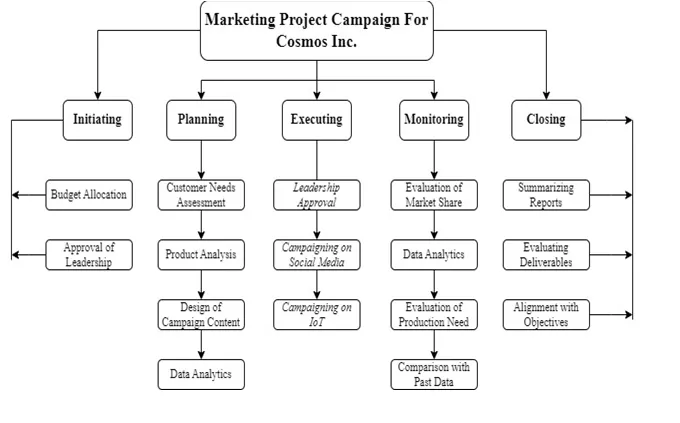
WBS Introduction
WBS is a useful tool for planning and controlling a project. It breaks down big tasks and parts of the project to simplify large goals and assign specific tasks and parts to employees. In the marketing project case of Cosmo, Inc., the WBS will break down the case and include the market analysis and objectives for customer service, along with the various steps and tasks needed for the successful execution of the project (Tikkanen et al., 2023). It works to define and break down project goals and objectives. WBS is also very useful for monitoring and tracking the scope of the project. Using WBS for a project allows for the project to be completed within the original scope and budget.
WBS Graphical Representations
Project Management Cost (Budget)
Introduction (Intent)
A project management budget is a detailed budget of a plan that shows the estimated costs of project activities. According to Bchennaty et al. (2024), strategic financial planning refers to the optimal use of resources throughout the lifecycle of projects. For the purpose of the construction and implementation of the innovative marketing strategy of Cosmos Inc., the financial plan divides expenses into three categories and places them in order of importance. Cosmos Inc. would allocate its first priority budget item to employ top-level technical experts. This is in order for Cosmos Inc. to harness the power of the Internet of Things (IoT), social media, and data analytics and integrate them into the marketing system. This research has noted that the recruitment of technical experts has been shown to produce significant positive impacts on the digital transformation of organizations (Sobczak, 2025). This prioritization ensures that the foundational technical capability is secured before other project costs are committed. The second financial group consists of total project-related personnel costs and 40 days of project-related pay and incentive costs. The last cost/budgetary item deals with costs related to purchasing and the execution of the budgetary costs. The total financial budget for the three prioritized groups is 150,000 dollars. It is recognized that the actual costs/expenses may vary; thus, a reserve of 15,000 (10% of the base) has been set aside.
Project Budget
Project Management Budget Summary | ||
Categories | Tasks | Expense |
Hiring | Specialized Technical Professionals | $11,000 |
Team Development Training | $2,000 | |
Website Platform Creation | $5,000 | |
Execution Expenditures | Promotional Content Support | $15,000 |
Product Assessment | $7,000 | |
Consumer Requirement Evaluation | $10,000 | |
Analytical Data Processing | $15,000 | |
Market Position Analysis | $10,000 | |
Production Capacity Evaluation | $5,000 | |
Performance Comparison Analytics | $20,000 | |
Comprehensive Project Review | $10,000 | |
Workforce Management | Employee Compensation | $30,000 |
Performance-Based Rewards | $10,000 | |
Total | $150,000 | |
Contingency | Unexpected Events or Inflation | $15,000 |
Total | $165,000 | |
The budget allocation aligns with the long-term financial promotion target set for Cosmos, with the company aiming to strengthen its market penetration. The closer the budget is to the organization’s vision, the greater the competitive advantage, as stated by Suwarno et al. (2023). Investments made by the firm on IoT-based and social media marketing programs will enable the firm to strengthen its customer base while differentiating its products to strengthen future innovations. EC human capital expenditures and talent acquisition may carry significant risks in exceeding the initial estimates. The forces may be pressures concerning economic inflation or changes in competition among specialized professionals. The contingency allocation of 10 percent that is incorporated in the budget offers a cost-cutting measure to these financial risks, which makes the overall budget to be 165, 000.
There are various categories of project cost expenditures, such as hiring technical professionals, workforce management, and execution expenditures. The main limitation is in the cost estimation of specialized professionals, which might turn out to be higher than expected due to situations like the market and competition. Moreover, workforce-expense items like employee compensation and performance-based incentives may blow the budget because of market pressures or inflation. The expenses related to the execution, including the support of promotional content and data processing, can also experience price fluctuations caused by new technologies or by changing requirements, for example. A contingency of 10%, allocated in the budget, provides flexibility if there are unexpected expenses or inflation.
Project Management Schedule
Introduction (Intent)
The Cosmos initiative has 12 distinct activities that must be scheduled for timely execution for the new marketing strategy to be effective. Studies have shown that timelines and schedules are directly related to stakeholder satisfaction and success rates (Motalebi et al., 2025). Each operation has prerequisite activities that must be completed before all are positioned for execution. The activities for the social media and IoT promotional campaign will include consumer needs analysis, market positioning, assessing production and product capabilities, data and process analysis, and performance benchmarks at an advanced level. Shen et al. (2022) argued that knowledge and understanding of the task sequence are critical for effective project scheduling. This structured sequencing also helps project managers anticipate resource bottlenecks before they occur. Accordingly, the following schedule provides the 12 essential project milestones reflecting the three budgetary classes, and in accordance with the Work Breakdown Structure (WBS) of Cosmos Inc.
Microsoft Project Document
Task Name | Start | End | Duration (days) |
Recruitment of Technical Specialists | 5/1/2025 | 5/4/2025 | 3 |
Team Member Training Program | 5/4/2025 | 5/6/2025 | 2 |
Webpage Design and Development | 5/4/2025 | 5/10/2025 | 6 |
External Campaign Content Procurement | 5/11/2025 | 5/15/2025 | 4 |
Comprehensive Product Examination | 5/15/2025 | 5/20/2025 | 5 |
Consumer Requirements Analysis | 5/20/2025 | 5/26/2025 | 6 |
Data Analytics Processing | 5/6/2025 | 5/25/2025 | 19 |
Market Position Assessment | 5/11/2025 | 5/24/2025 | 13 |
Production Capacity Assessment | 5/15/2025 | 5/27/2025 | 12 |
Performance Benchmarking via Analytics | 5/25/2025 | 5/30/2025 | 5 |
Social Media and IoT Promotional Initiative | 6/1/2025 | 6/8/2025 | 7 |
Concluding Project Assessment | 6/8/2025 | 6/10/2025 |
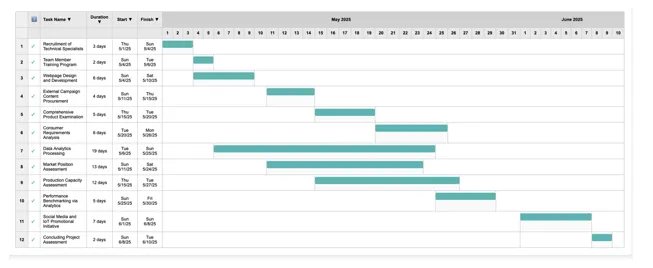
The developed project’s schedule has activities that involve detailed analyses of various products, consumers, data, and market positions. The strategy for effective use of time proposes that these activities be done simultaneously to meet the objectives of the project. The evaluation of the entire project will be possible after the base segments of the marketing policy, social media marketing, and the promotional project of IoT are fully operational. In project management, the sequential dependencies ensure the logical and qualitative sequential advancement of the workflow (Ismail & Salama, 2025). After 40 days (May 1, 2025, to June 10, 2025), the plan for this project is anticipated to increase the marketing strategy’s implementations and infrastructures within the organization. Thus, the project is intended to increase the market penetration, customer, and production capacity of Cosmos Inc. to optimal levels. The project is set up to be done in phases, and there are no dependencies or sequential commissions; for example, the recruitment, team training, and webpage design are all going on at the same time, and there is no need to wait for one task to be completed before starting the next one. Dependencies are highlighted in the schedule, such as the product examination, consumer requirements analysis, and data processing, which are undertaken prior to launching the IoT and social media promotional activities. This series and parallel processing of tasks guarantees that the project is completed within the schedule, and finally, is in line with the company’s goals of market penetration, expanding the customer base, and optimising production capacity. The well-structured timeline is directly related to the strategic goals of the corporation, and it is important to note that it assures both the quality and effectiveness of the marketing campaign, thanks to a logical progression.
Risk Management Plan
Introduction
In this plan, potential risks that could affect the project scope, its cost, and its schedule and quality are identified. A qualitative analysis of probability (Low, Medium, High) and impact of the risks (Low, Medium, High) is done. The mitigation plans aim to minimize the adverse outcomes and ensure the projects’ success.
Risk Matrix
Introduction and Legend (Intent)
The Risk Matrix helps to categorize and assess each risk in terms of likelihood and impact.
- Low (L): ≤20% probability or minor impact
- Medium (M): Likely (21-60% chance) or moderate impact
- High (H): > 60% likelihood or significant impact on project goals
Risk Description | Probability (L, M, H) | Impact (L, M, H) | Risk Owner | Risk Response (Mitigation) |
Staff resistance to adopting new technologies (AI/IoT integration) | M | H | Project Manager & HR Department | Provide comprehensive training, change management workshops, and incentives to encourage adoption. |
Ineffective targeting of customer segments leads to poor campaign performance | M | H | Marketing Team Lead | Utilize real-time analytics to adjust segmentation; conduct A/B testing and refine campaigns based on live data. |
Technical issues during AI or IoT integration are causing delays | M | M | IT Department | Conduct extensive pre-launch testing and establish system backups; assign an on-call technical support team. |
Budget overruns due to fluctuating technology or labor costs | M | H | Finance Manager | Implement weekly budget audits; maintain a 10% contingency fund; review all procurement approvals. |
Market volatility or economic downturn impacting customer spending | L | H | Project Sponsor | Continuously monitor market trends; adjust campaign timing, scale, or pricing strategies as needed. |
Risk Analysis
The main risks regarding the Cosmo, Inc. Marketing Campaign include adherence to deadlines, data reliability, and financial risks. The main approach to project risks is cross-department collaboration along with active risk monitoring. The adaptability (Yang & Wang, 2023) will assist this. As part of the risk assessment process, potential threats will be analyzed. Consistent progress reporting and KPI dashboards will be used as proactive measures to accommodate outcome goals, provide minimal disruption, and execute timely measures.
Project Quality Plan
Introduction (Intent)
This plan makes certain that the marketing, technical, and compliance requirements are achieved and satisfied for all projected deliverables. This is similar to the PMBOK and ISO 9001 practices that strengthen a system focusing on efficiency, accuracy, and participation with the customer.
Plan Quality Management Processes
- Quantifiable performance measures of marketing and technical products are established as a result of the input of the plan, scope, baseline, and stakeholder register, in addition to a quality policy (Sesana et al., 2024).
- Tools and Techniques: Quality Metrics can be developed to assess the campaign using Benchmarking and Cost-Benefit Analysis.
- This process will result in the creation of a Quality Management Plan (QMP), Inspection Check Lists, and the identification of KPIs (Key Performance Indicators).
Key Metrics
Marketing accuracy rate > 95%
Data processing accuracy > 98%
Customer satisfaction > 90%
Manage Quality Assurance
- Process performance assessment and efficiency are based on its inputs: the QMP, deliverables, and performance reports.
- Knowledge of Tools and Techniques such as Internal Audits, process reviews, and FMEA, identifying areas for improvement and consistency across campaign stages (Hosseinpoor et al, 2024).
- At this stage, any outputs such as audit reports, recommendations for process improvement, and accepted corrective actions that can improve future performance are produced.
Control Quality
- The deliverables, test results, and KPIs are analyzed to ensure the campaign results align with the organization’s needs (Zieger et al., 2023).
- Quality tools such as control charts, defect tracking logs, and inspection reports help to identify and address anomalies.
- Desired outcome: This guarantees that all offered marketing products are validated, with documented corrective action schemes and performance, and are therefore of high quality.
Project Close and Lessons Learned
At project closure in Cosmo, Inc, deliverables were checked and verified together with project sponsors and project stakeholders to ascertain whether project objectives were met and to what extent the objectives were approved and/or accepted. Financial closure was achieved by checking project expenditures against the budget balances, and project resources were released. All the campaign data, analytics, and documentation were preserved for future use, and the marketing systems were improved, made operational, and handed over for all business activities.
Factors that contributed to the success of the project included the support of senior management, interdepartmental collaboration, and clear goals and objectives. Additionally, the project benefited from the incorporation of artificial intelligence and predictive analytics, as these were used to establish the content and traffic for the campaign in order to optimize the distribution. This project was aligned by transparent communication and stakeholder engagement during the life cycle of the project.
The key learnings included the necessity for the early provision of training and the incorporation of change management for the purpose of minimizing the resistance of personnel, the establishment of continuous data feedback loops, and proactive budgeting and resource tracking in order to avoid overage (Aranda-Usón et al, 2024). Cosmo, Inc. intends to improve its early risk forecasting, optimize its procedural AI tools, and strengthen its knowledge repository in terms of lessons learned for the purpose of continuous improvement and ensuring that project management best practices are employed in subsequent projects.
AI Use Analysis
At Cosmo, Inc., AI played an important role in developing project documentation and organizing a marketing campaign. Based on PMBOK and Capella MBA requirements, excellent prompts were developed to create risk matrices, draft outlines, and budget plans. Each section of the paper was evaluated to ensure that the information met the project goals and that the use of AI tools complied with academic integrity (Aranda-Usón et al., 2024). I was able to optimize the data. The context, accurate data, and corporate ethics were achieved through manual edits and ensured realism.
AI was the least productive and least effective. It was not even useful as a collaborative tool. Drafting, summarizing, and formatting were easily done through the tool, but the project manager had to edit and check all the end results. The control maintained moral integrity, factual accuracy, and served as the benchmark for the best practice, ethical, and responsible use of AI in business and education.
[/blur_section]